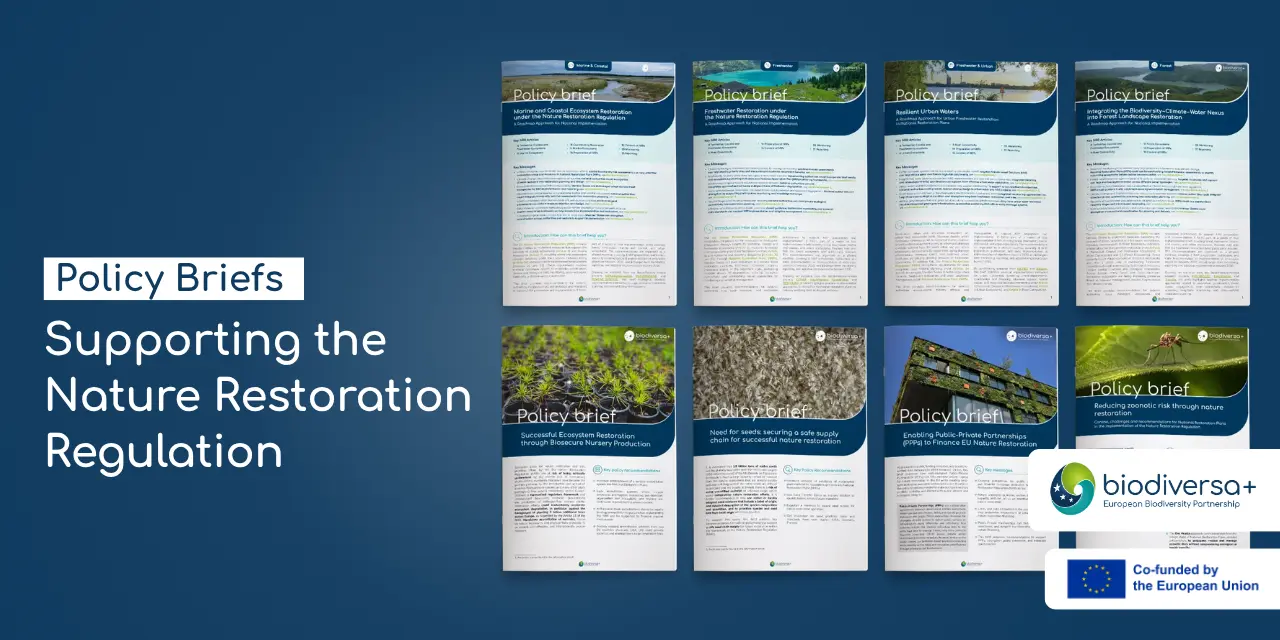
Biodiversa+ published a series of eight policy briefs translating a decade of research and recommendations on ecosystem restoration into practical, phased guidance tied directly to the articles of the EU Nature Restoration Regulation (NRR) and the requirements of the National Restoration Plans (NRPs). As EU Member States will submit their draft NRPs to the European Commission by 1 September, the NRR is entering a critical phase. The briefs provide policymakers with guidance and policy recommendations based on European research and practical experience.
The briefs fall into two groups:
- The ecosystem roadmaps, providing phased implementation guidance for specific habitat types. Those briefs are based on concrete case studies of projects funded under the BiodivRestore Call, in collaboration with Water JPI.
- The enabling conditions, addressing what’s needed for restoration to succeed at scale. Those briefs were prepared by the BiodivRestore Knowledge Hub (KH).
Context
The Nature Restoration Regulation (NRR), established in 2024, is a key element of the EU Biodiversity Strategy for 2030, setting targets for the restoration of degraded ecosystems. What goes into the National Restoration Plans will shape nature restoration across Europe for decades.
The NRPs follow the following timeline:
- 1 September 2026: Submission of draft NRPs to the European Commission (one for each EU Member State).
- Spring 2027: Revision of the NRPs by the European Commission.
- September 2027: Final Submission of the NRPs.
Nature restoration is not only about reversing biodiversity loss. Restoring healthy, functioning ecosystems can simultaneously support biodiversity, climate resilience, water systems and human health. Delivering these interconnected benefits requires restoration to be planned across sectors and at the appropriate ecological level, while putting in place the practical conditions needed for restoration to succeed at scale.
The ecosystem roadmaps
The four briefs provide practical, phased implementation guidance tied to NRPs timelines covering the 2026-2028 early implementation window, the 2030 targets, and the longer-term 2040-2050 milestones.
- Integrating the Biodiversity – Climate – Water Nexus into Forest Landscape Restoration: restoring forests is not only about biodiversity. Healthy forests support climate resilience, water regulation and freshwater ecosystems, making them a clear example of the biodiversity–climate–water nexus. Research looking at 52 freshwater species under scenarios extending to 2100 shows the importance of restoring rivers and the forests around them together.
- Marine and Coastal Ecosystem Restoration: restoring marine and coastal ecosystems can boost biodiversity and climate resilience, but it remains costly, slow and chronically underfunded compared to terrestrial restoration. Research on seagrass, macroalgae and coral shows that today’s best restoration sites may become unsuitable as the climate changes, making smart, forward-looking site selection the key priority for Member States.
- Resilient Urban Water: urban rivers and wetlands can support biodiversity, improve water quality, regulate flooding and strengthen climate resilience, when designed right. An assessment of 60 Nature-based Solutions (NbS) across five European cities reveals that aquatic habitat diversity and integrated water governance support high ecological quality and species diversity. NbS can support biodiversity while also strengthening cities’ resilience to climate change.
- Freshwater Restoration: freshwater ecosystems don’t recover site by site, they depend on connected river systems. Evidence from 226 river restoration projects across Europe shows why water quality, habitat and land use must be planned at catchment scale, and why climate change makes forward-looking connectivity even more critical.
The enabling conditions
These four briefs address the requirements that must be in place for ecosystem restoration to succeed at the scale required by 2030.
- Reducing zoonotic risk through nature restoration: nature restoration is also a public health investment. More than 75% of emerging infectious diseases originate in animals, yet a review of 30 restoration and health policies since 2015 found only 10% address the unintended health or social consequences of restoration. Health considerations must be integrated into NRPs.
- Need for Seeds: Securing a Safe Supply Chain for Successful Nature Restoration: restoration will need billions of native seeds, but even in countries with certification frameworks for a decade, like Germany and France, 90% of the market remains uncertified. With no EU-wide standard, securing a reliable native seed supply is not a technical detail but a strategic prerequisite for restoration.
- Successful Ecosystem Restoration through Biosecure Nursery Production: surveys of more than 2500 nurseries and planting sites across Europe uncovered over 120 Phytophthora species (pathogens) hiding in plant material that then becomes a pathway for the spread of invasive plant diseases. Pathogen-free nurseries are a prerequisite for successful ecosystem restoration.
- Enabling Public-Private Partnerships (PPPs) to Finance EU Nature Restoration: nature restoration faces a €65 billion annual funding gap in Europe, and it’s not just an ecological problem. With 72% of EU corporations and nearly 75% of Euro-area bank loans tied to nature-dependent sectors, ecosystem degradation is now a financial risk too. Well-designed public-private partnerships can help mobilise private capital while safeguarding ecological integrity and delivering measurable social and economic benefits.