
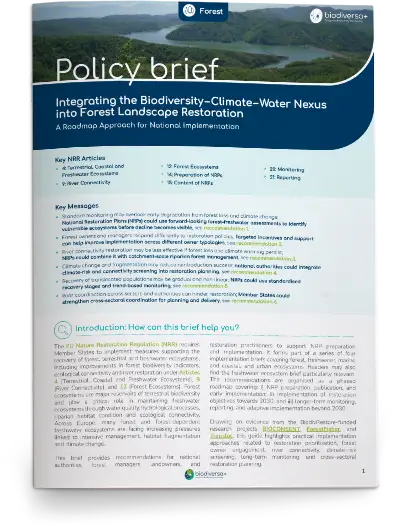
Policy Brief: “Integrating the Biodiversity – Climate – Water Nexus into Forest Landscape Restoration”
Published: June 2026 |
Forest ecosystems are major reservoirs of terrestrial biodiversity. They play a key role in maintaining healthy freshwater ecosystems by improving water quality, regulating the water cycle, protecting riparian habitats and ensuring ecological connectivity for species. Across Europe, many forest and forest-dependent freshwater ecosystems are facing increasing pressures linked to intensive management, habitat fragmentation and climate change.
This policy brief provides recommendations for national authorities, forest managers, landowners, and restoration practitioners to support National Restoration Plans, required in the context of the EU Nature Restoration Regulation. It brings together insights from three BiodivRestore research projects:
- BIOCONSENT, on decision-making support for forest restoration
- ForestFisher, on conservation and restoration of Amazonian forest-frugivorous fish interactions
- Transloc, on translocations of flora and fauna for conservation and restoration
This brief is part of a series of eight policy briefs about Nature Restoration.
Key messages:
- Freshwater habitats may become vulnerable before degradation is visible through conventional monitoring. Forward-looking cross-sector assessments, combining forest cover, freshwater connectivity and climate projections are needed to prioritise areas and connectivity measures.
- Targeted incentives can help different types of forest owners implement and support the restoration measures, and counter behavioral inertia.
- Climate-risk and connectivity screening can help identify the suitable species release sites under future climate and land-use conditions. Considering long-term habitat suitability and connectivity is crucial for selecting release sites.
- Standardised recovery stages help long-term monitoring.
- Cross-sectoral coordination across competent authorities improves alignment between restoration, land-use, freshwater and climate-related policies. Misalignment between sectoral policies, governance responsibilities and land-use priorities can affect restoration implementation.