Other languages
These translations are provided for information purposes. In the event of any discrepancy, please refer to the original English version.
Policy Brief: “Need for Seeds: Securing a Safe Supply Chain for Successful Nature Restoration”
Published: June 2026 | DOI: 10.5281/zenodo.21359997
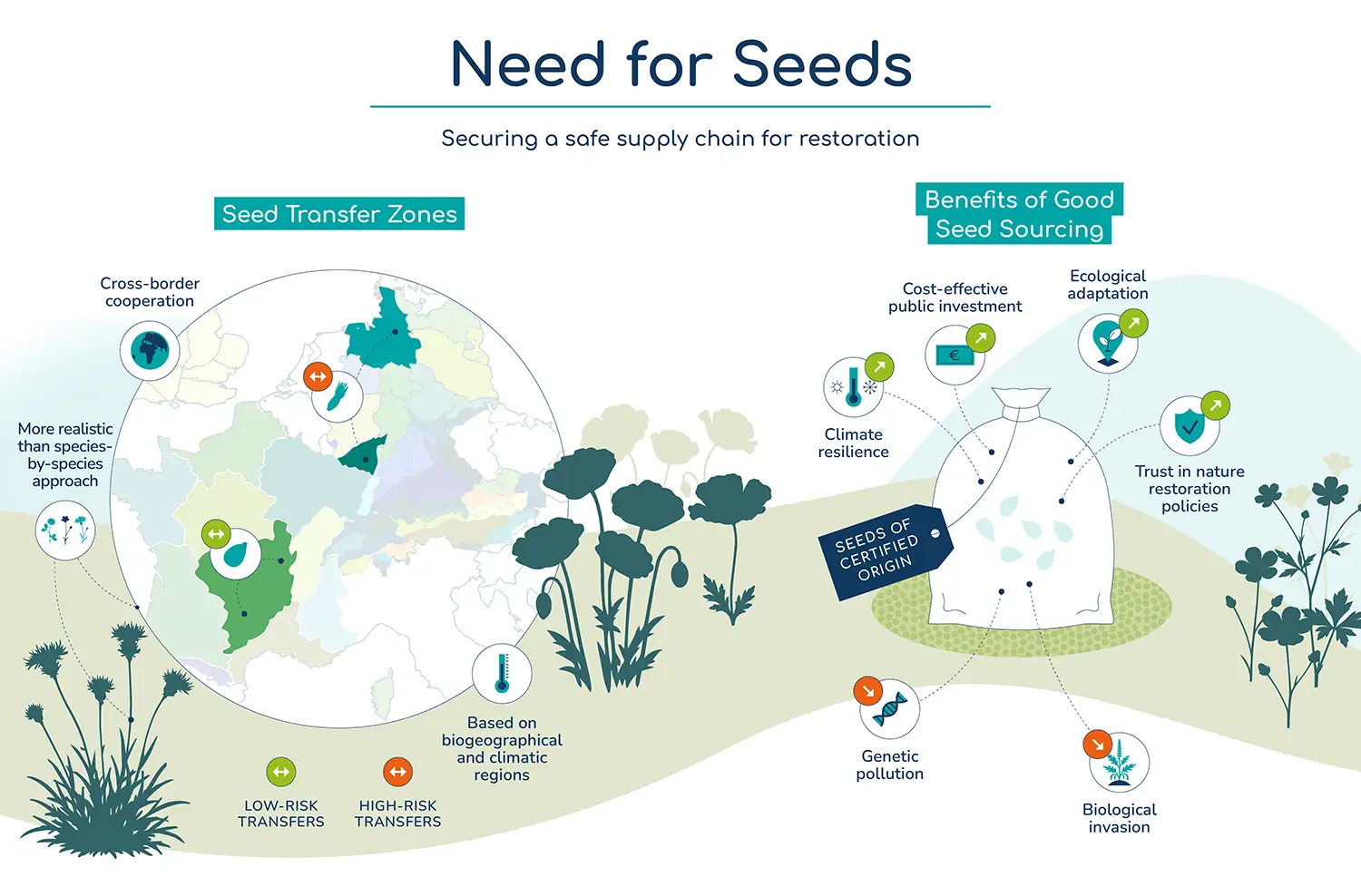
Seeds lie at the foundation of ecosystem restoration: because plants form the structural basis of ecosystems, the choice of seeds used in restoration is a critical policy decision, not a minor technical detail. The origin of seeds determines plants’ ecological adaptation and climate resilience, and helps prevent risks such as genetic pollution and biological invasion. Functional, resilient and sustainable ecosystems start with planning seed needs in advance, securing the supply chain, and ensuring the right seed mix, of local origin and with a detailed description of species composition.
Effective restoration requires the active introduction of plant material through sowing, planting, or hay transfer. In many European landscapes, habitat fragmentation, depleted soil seed banks, and a lack of ecological connectivity mean that natural regeneration alone is often not enough to bring an ecosystem back to life.
With 1.9 billion tons of native seeds needed globally to meet the restoration targets of the UN Decade on Ecosystem Restoration, and with the need to plan seed requirements three to four years in advance, securing the supply chain is a key issue. At the moment, 90% of the European market is still dominated by uncertified seeds.
This brief emerged from the BiodivRestore Knowledge Hub, a network of researchers and stakeholders collaborating to empower countries in developing and implementing National Restoration Plans. It is part of a series of eight briefs about Nature Restoration. This Policy Brief provides recommendation on how to avoid risky restoration, highlighting good practices for securing the seed supply chain, to move forward toward the implementation of the Nature Restoration Regulation.
Key messages:
- Poor seed sourcing carries real risks: genetic pollution, biological invasion, and loss of climate resilience. These consequences can undermine years of restoration effort and erode public trust in restoration policy.
- National policymakers implementing the Nature Restoration Regulation face a triple constraint: using local seed material to preserve genetic diversity, meeting the massive volumes required by 2030, and anticipating climate change. Prestoration (planting species suited not just to today’s conditions but to a site’s future climate) is increasingly essential alongside strictly local sourcing.
- Seed Transfer Zones, based on biogeographical and climatic regions, are more realistic than a species-by-species approach, especially for herbaceous species where rules of provenance rarely exist. They allow for cross-border cooperation, e.g., across the Alps or shared river basins.