
Other languages
These translations are provided for information purposes. In the event of any discrepancy, please refer to the original English version.
Policy Brief: “Marine and Coastal Ecosystem Restoration under the Nature Restoration Regulation”
Published: June 2026 |
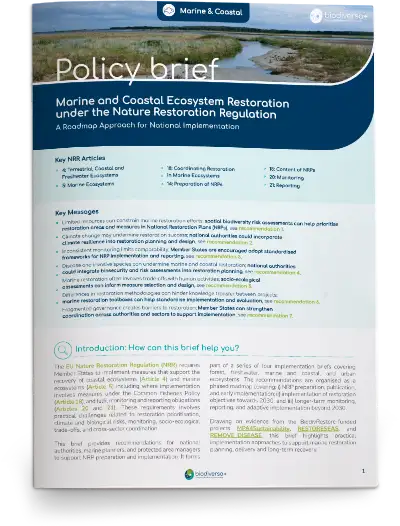
Restoring marine ecosystems is not simply about restoring more places. With limited resources and rapidly changing oceans, the priority question is not whether to restore but where. Spatial risk mapping, climate resilience screening, and standardised monitoring should determine where marine restoration will have the greatest and most durable ecological impact. Marine restoration is costly, technically demanding, and slow to show results, and it remains significantly underfunded and underplanned relative to terrestrial restoration.
This policy brief provides recommendations for national authorities, marine planners, and protected area managers to support National Restoration Plans, required in the context of the EU Nature Restoration Regulation. It brings together insights from three BiodivRestore research projects:
- MPA4Sustainability, on the role of Marine Protected Areas in biodiversity restoration.
- RESTORESEAS, on nature-based tools to protect and restore marine forests.
- REMOVE_DISEASE, on infectious diseases in seabirds across degraded insular biodiversity.
This brief is part of a series of eight policy briefs on Nature Restoration.
Key messages:
- Cumulative biodiversity risks (ecological condition, human pressures, species sensitivity) must be assessed to prioritise restoration areas and marine management measures, and to support evidence-based marine spatial planning.
- Climate change must be taken into account when planning marine restoration, as it may affect the future suitability of measures.
- Standardised monitoring across restoration projects strengthens restoration progress tracking.
- Knowledge exchange between restoration programmes supports consistent implementation of restoration measures.
- Cross-sector coordination and information-sharing processes between policies and authorities across borders strengthen coherent restoration planning and implementation.