Research on the biodiversity and social implications of European blue food consumption is growing, but it does not yet provide a complete picture.
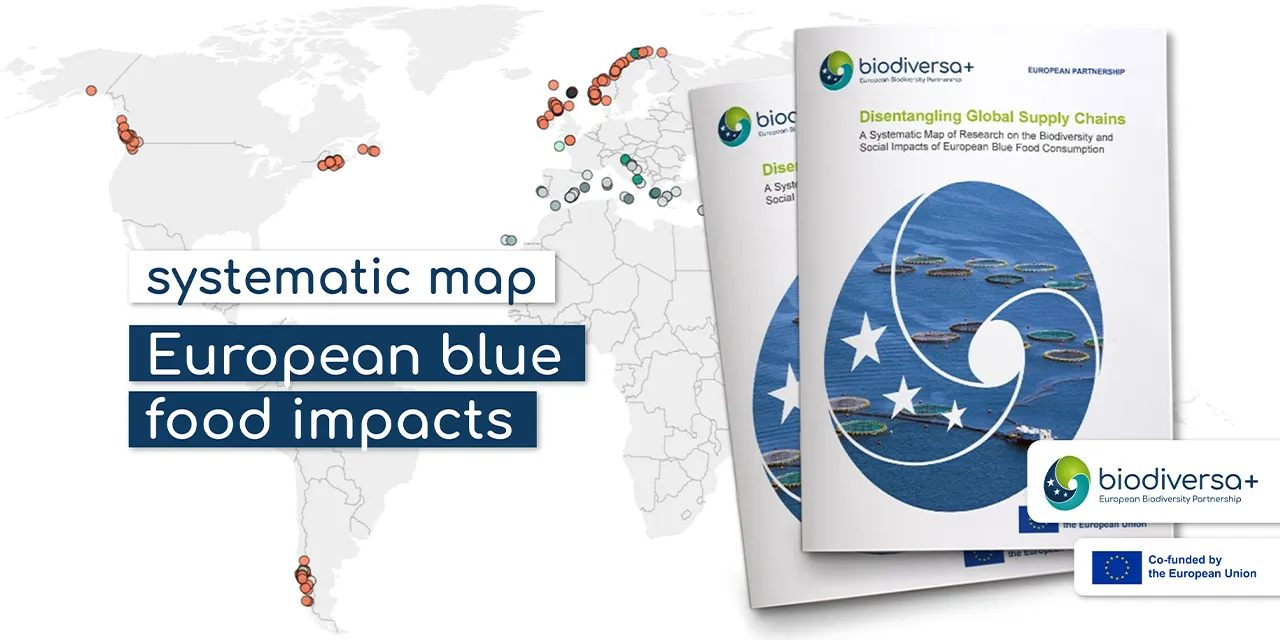
A new Biodiversa+ systematic map, “Disentangling Global Supply Chains”, examines what research tells us about the impacts of European consumption of farmed cod, salmon, sea bass and gilthead sea bream. It finds that evidence is strongly concentrated on a limited set of species, impacts, places and production stages.
The map included 210 relevant studies, identified by screening a random 60% subsample of more than 28,000 search results. Rather than assessing whether European blue food consumption is sustainable overall, it shows where research is concentrated and where important gaps remain.
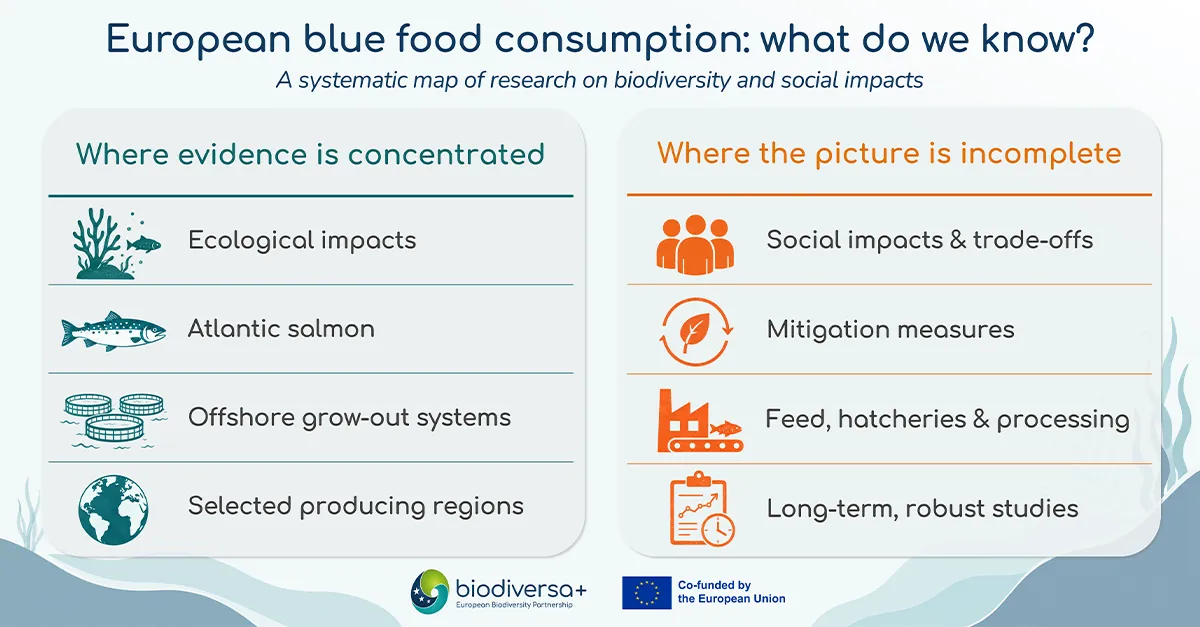
Evidence clusters around salmon and farm-level ecological impacts
Atlantic salmon dominates the evidence base, with studies concentrated in major producing regions including Canada, Chile, Norway and the United Kingdom. Sea bass and gilthead sea bream are also represented, mainly in Mediterranean countries, while cod receives comparatively little attention.
Most studies focus on ecological outcomes and on the adult grow-out stage in offshore pens. Research is particularly well represented on benthic communities, interactions with wild fish, pathogens, sea lice and organic pollution pathways.
These clusters could provide a basis for more focused evidence synthesis, helping move from mapping where studies exist to assessing what the available evidence shows in particular contexts.
Important parts of the picture remain less visible
Social impacts are much less studied than ecological impacts. The map found too few studies on key dimensions such as land and resource access, labour conditions, food security and food sovereignty in producing regions. Only one study examined social and ecological outcomes together, limiting understanding of how biodiversity impacts may translate into social consequences and trade-offs across supply chains.
Research also remains strongly focused on farm-level grow-out. Feed production, hatcheries and early life stages, processing and post-harvest activities receive far less attention, even though these stages can shape the wider biodiversity and social implications of European blue food consumption.
Evidence on mitigation measures is similarly limited. Only six studies examined measures intended to reduce impacts, most of them related to sea lice management or recovery after farm closure.
Supporting more targeted research and synthesis
The map highlights two complementary needs. Some areas require new research, particularly on social impacts, supply-chain stages beyond grow-out, mitigation measures and more integrated social-ecological approaches. Other areas may already be suitable for further synthesis, including benthic and microbial impacts of salmon farming, wild fish interactions, organic pollution and sea lice.
By identifying both evidence clusters and gaps, the study provides a basis for more targeted research, knowledge synthesis and policy discussions on blue food systems.