
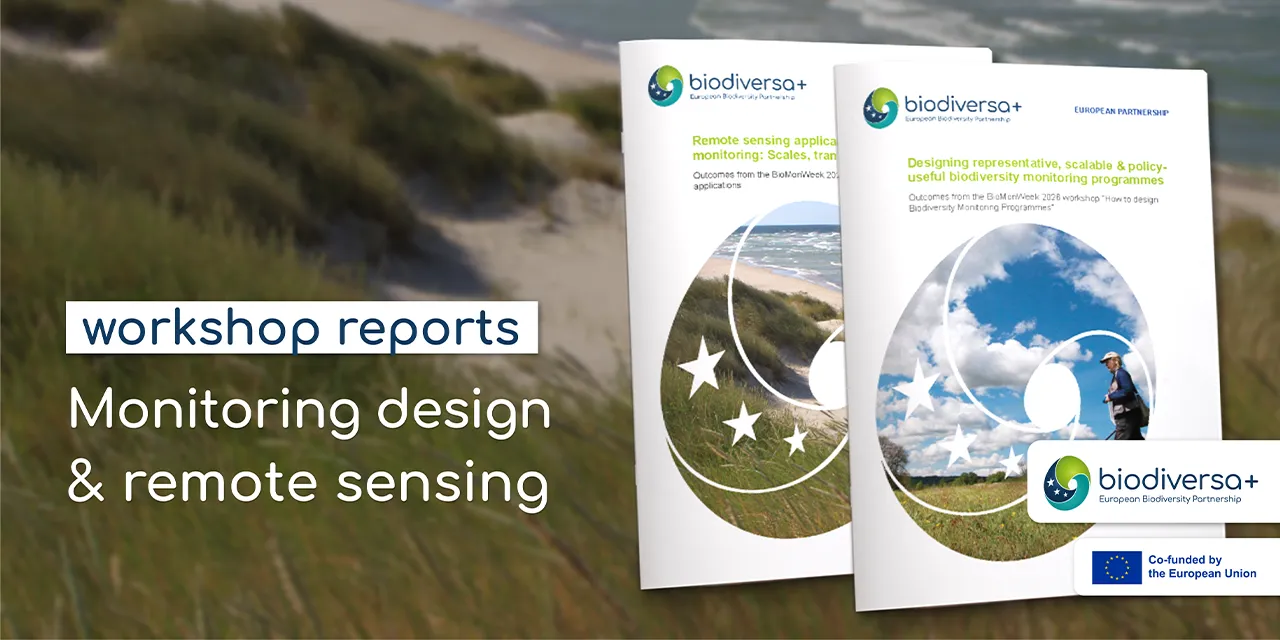
Turning biodiversity monitoring data into useful evidence for decision-making requires more than larger datasets. It also depends on robust design, transparent methods, reliable validation and clear links between evidence and policy needs. Biodiversa+ publishes two new reports from BioMonWeek 2026, each addressing a different part of this challenge.
Two perspectives on policy-useful biodiversity monitoring
The reports summarise outcomes from two interactive workshops held on 7 May 2026 in Montpellier, France:
- The first report, Designing representative, scalable and policy-useful biodiversity monitoring programmes, focuses on how monitoring schemes can be designed to support credible inference. It highlights the importance of clear sampling frameworks, representativeness, spatial coverage, harmonisation and governance. A key message is that good variables and protocols are not enough if the sampling design is unclear or biased. Monitoring programmes need to define what they are intended to represent, how sites or units are selected, and what conclusions can validly be drawn from the data. The report also points to the need for “minimum common requirements” to support comparability across countries, while allowing flexibility for national contexts and existing monitoring schemes.
- The second report, Remote sensing applications for biodiversity monitoring: scales, transparency and drones, focuses on the growing role of remote sensing, predictive modelling and drone-based data in biodiversity monitoring. It highlights the potential of satellite, airborne and drone-based observations to complement field monitoring and support large-scale assessments. But it also stresses that model outputs should not be taken at face value. Their reliability depends on data quality, modelling choices, validation, uncertainty reporting and the scale at which they are developed and applied. The report also underlines the need for clearer standards for drone data collection and better integration between plot-based field data, drone imagery and satellite observations.
Better monitoring needs trustworthy systems
Together, the two reports show that improving biodiversity monitoring depends on more than better technology or additional observations. It requires trustworthy systems, with clear monitoring design, robust data collection and validation, transparent communication of uncertainty, and outputs that can be translated into usable formats for decision-makers.
For public authorities, monitoring agencies, researchers, remote sensing specialists, data managers and policy makers, the reports point to a practical direction: biodiversity monitoring systems that are more representative, transparent and fit for policy use, enabling biodiversity data to better support robust evidence, European coordination and effective policy implementation.