After the objectives set at COP15 and the tools agreed at COP16, COP17 was a decisive moment to take stock of progress and accelerate implementation of the Kunming-Montreal Global Biodiversity Framework (KMGBF) as it enters a second phase, running until 2030.
Science is a key element in assessing and monitoring the state of biodiversity, identifying which interventions deliver lasting results, and understanding how ecosystems respond over time. It provides the evidence for decision-makers to take action for nature.
COP17 closed on a mixed note: the Yerevan Pathway and a successful global review demonstrated that multilateralism still works, while issues that were previously overlooked are finally being addressed. However, the first global review also confirmed that progress remains insufficient to meet the 2030 targets. Despite agreements on resource mobilisation, significant financing gaps persist, and decisions on the structure of a future financial mechanism were deferred to COP18.
Science for biodiversity
Academia was well represented at COP17, through global scientific networks and numerous research performing organisations. Science was also challenged: Parties engaged in discussions on the formal recognition or endorsement of the recent IPBES assessments (Nexus, Transformative Change and Business). Yet for the first time at a COP, policy options from IPBES assessments are included in the decision text, which should foster their greater uptake.
Many CBD Parties, particularly in Europe and Africa, stood up for science throughout the discussions. Led by Switzerland, 55 countries delivered the Friends of Science statement, reaffirming the irreplaceable role of independent science as a basis for decision-making.
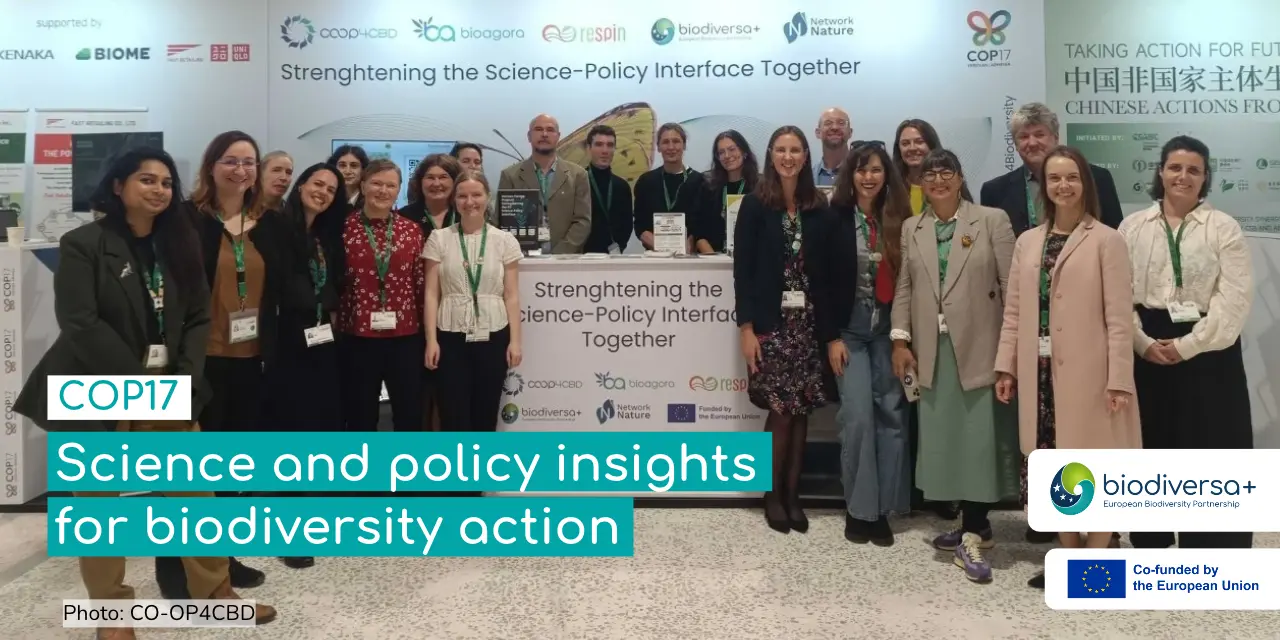
The EU-funded initiatives Biodiversa+, CO-OP4CBD, BioAgora, RESPIN and NetworkNature were together at COP17 to make the best available science accessible and actionable, showcasing it at our joint booth and during the side events we co-hosted. Several Biodiversa-funded projects attended COP17 to showcase the relevance of their findings to the CBD. To support this engagement, the recently released UN CBD Toolkit for Experts and Knowledge Holders was presented, helping funded researchers engage with the Convention.
Biodiversa+ also specifically contributed to the global review in early 2026 and supports the implementation of targets with its portfolio of activities.
Key takeaways
The side events hosted by Biodiversa+ and partners explored how science can provide the evidence for policy and action for nature. Here are the key takeaways from the discussions.
Science-policy interface
- Evidence must be turned into action. The challenge is to access data and translate it into effective, science-based policies.
- Enhancing capacity-building materials and tools for experts and knowledge holders is fundamental
- Combining different knowledge systems leads to stronger decisions. Indigenous Peoples and Local Communities stress the value of bringing their knowledge together with scientific knowledge, and of guaranteeing their right to participate in governance. IPBES assessments already show the benefits of such synergies.
- Simple, well-timed messages help science reach the public debate. The next challenge will be to bring the absent actors to the table.
Biodiversity monitoring
- Combine tools. Earth observation is powerful but underused, and works best when combined with field data and models. Satellites capture the structure and change that affect biodiversity. Together with field data and models, they give a fuller picture.
- Coordinate and harmonise. Monitoring is fragmented and needs coordination. Europe faces funding gaps, limited coverage and poorly connected data. The EBOCC Preparatory Action aims to improve coordination and data integration based on FAIR principles.
- Transparent, automated reporting makes results clearer.
- Monitoring needs a sustainable system. Long-term data and robust methods remain the main challenges.
Nature-based solutions (NbS)
- Working with nature delivers several benefits at once: some NbS can deliver for climate and biodiversity simultaneously.
- Cost efficiency, revenue generation, risk mitigation and social licence to operate make NbS relevant to companies.
- Real-world test sites, like Living Labs, help solutions take root. Long-term sites where farmers, researchers and policymakers test solutions together can turn them into practice.
Private sector engagement
- Businesses need better data. The IPBES Business assessment identified more than 38 knowledge gaps, notably in data accessibility, transparency and business-relevant data.
- Practical tools engage the private sector. The Biodiversa+ Business and Biodiversity Toolkit helps companies navigate policy requirements, and use and share biodiversity data.
- Private investment in nature protection remains insufficient. Partnerships with the private sector and dialogue with finance ministries could be strengthened.
Explore the EU Science for Biodiversity program
| Date & time | Location | Event |
|---|---|---|
| 20 October
15:00, 18:00 |
EU Science 4 Biodiversity Booth | Presentation of the “UN CBD Toolkit for Experts and Knowledge Holders” |
| 20 October
16:00 – 17:15 |
Georgia Pavilion | Monitoring Biodiversity Across Scales: Harmonisation From Local to Global: how can local biodiversity observations be transformed into national indicators, harmonised regional evidence and global reporting? |
| 21 October
15:00 – 16:00 |
Nordic Pavilion | Science Policy Business Innovations for Biodiversity |
| 22 October
10:15-11:15 |
Pavilion IUCN Forum Room A | Let’s Build Our Story Together: Enhancing the Collective Biodiversity Narrative for Action |
| 22 October
15:00-16:00 |
SPITAK – Side-Event Room 2 | Connecting Climate, Biodiversity and Land: Synergies among the Rio Conventions in the EU context |
| 25 October
17:00-18:00 |
Geobon | From Monitoring to Reporting: Lessons and Perspectives from Transnational, Subregional and National Monitoring Initiatives |
| 27 October
11:30 |
Vayk Room 3 | Bridging science and negotiations: how to develop briefs that matter? |
| 27 October
15:00 – 18:00 |
EU Science 4 Biodiversity Booth | Presentation of the “UN CBD Toolkit for Experts and Knowledge Holders” |
| 28 October
9:00 |
Pavilion Nature Positive | From biodiversity knowledge to Nature-Positive Finance: Scientific foundations for Action |
| 28 October
13:00 |
Komitas | Restoring degraded lands through NbS: agrobiodiversity, social dynamics, and climate resilience |
| 29 October
11:30 – 12:30 |
Data to Action Pavilion | From knowledge to action: empowering knowledge holders to engage in environmental and science-policy processes (CBD, IPBES, IPCC) |
| 29 October
15:30 |
Dutch Pavilion | Harnessing the Nexus: Biodiversity and Restoration in Saline Landscapes |