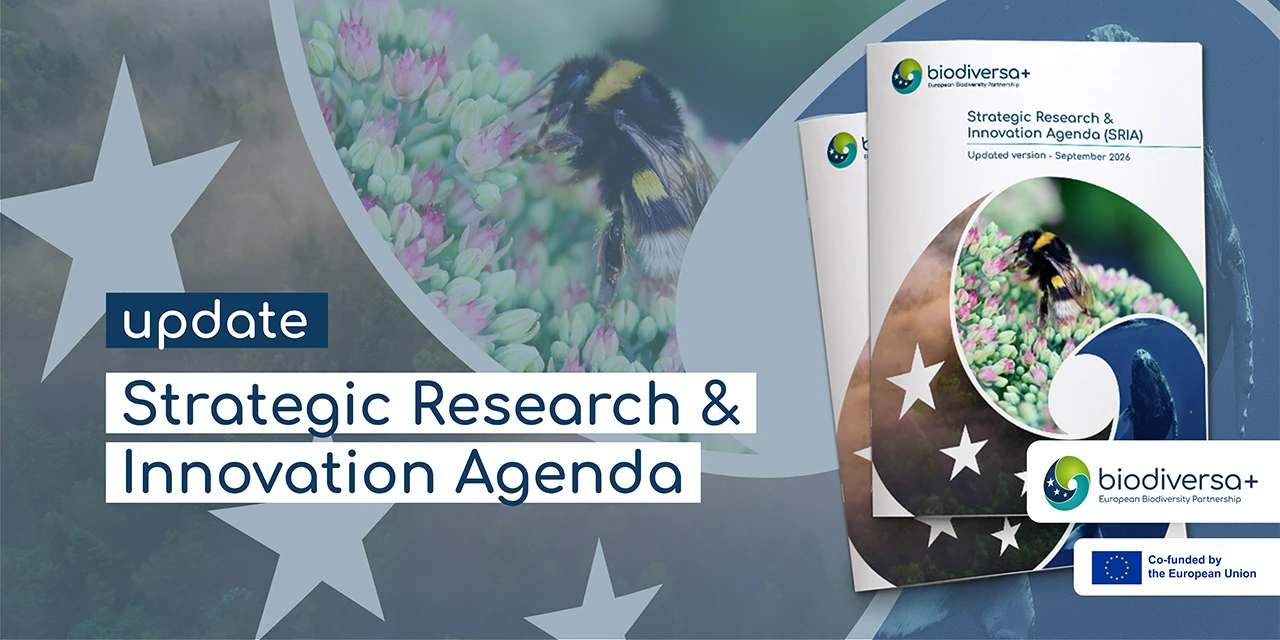
Biodiversa+ has published its updated Strategic Research and Innovation Agenda (SRIA), connecting its long-term ambitions for biodiversity with the priorities guiding research funding, monitoring and support for policy and practice.
Choosing where and how to protect and restore ecosystems requires evidence on which measures are effective. Assessing their outcomes depends on reliable monitoring, while implementation requires an understanding of the social, economic and governance conditions that enable change. These challenges are closely interconnected and often shared across countries. The SRIA provides a common framework for addressing them through coordinated efforts.
From strategic priorities to activities
Within Biodiversa+’s strategic framework, the SRIA sits between long-term overarching objectives and the planning of activities:
- The Partnership’s vision and objectives define what it aims to achieve. Biodiversa+ works towards the global vision of living in harmony with nature by 2050 and supports the EU ambition to put biodiversity on a path to recovery by 2030. The SRIA sets out the research and innovation priorities through which the Partnership contributes to these goals.
- The SRIA identifies the actionable knowledge needed to address this, with research priorities covering biodiversity protection and restoration, transformative change, the EU’s global action, biodiversity dynamics and Nature-based Solutions.
- Four multiannual flagship programmes bring related activities together, connecting research calls with monitoring, knowledge synthesis, capacity building and policy support.
- Annual Work Plans specify the activities to be undertaken, translating these priorities into the Partnership’s work.
This framework helps connect individual initiatives to shared objectives and sustain cooperation beyond a single project or funding call.
Reflecting developments in science and policy
The update draws on mapping and foresight activities, advice from the Biodiversa+ Advisory Board, and consultation with partners and the European Commission. It also reflects developments in scientific understanding and policy, including recent IPBES assessments, the Kunming-Montreal Global Biodiversity Framework and the EU Nature Restoration Regulation.
The agenda retains its structure of three topical and two cross-cutting themes, with stakeholder engagement, communication and open science supporting work across these themes to ensure that the knowledge produced is relevant, accessible and used.