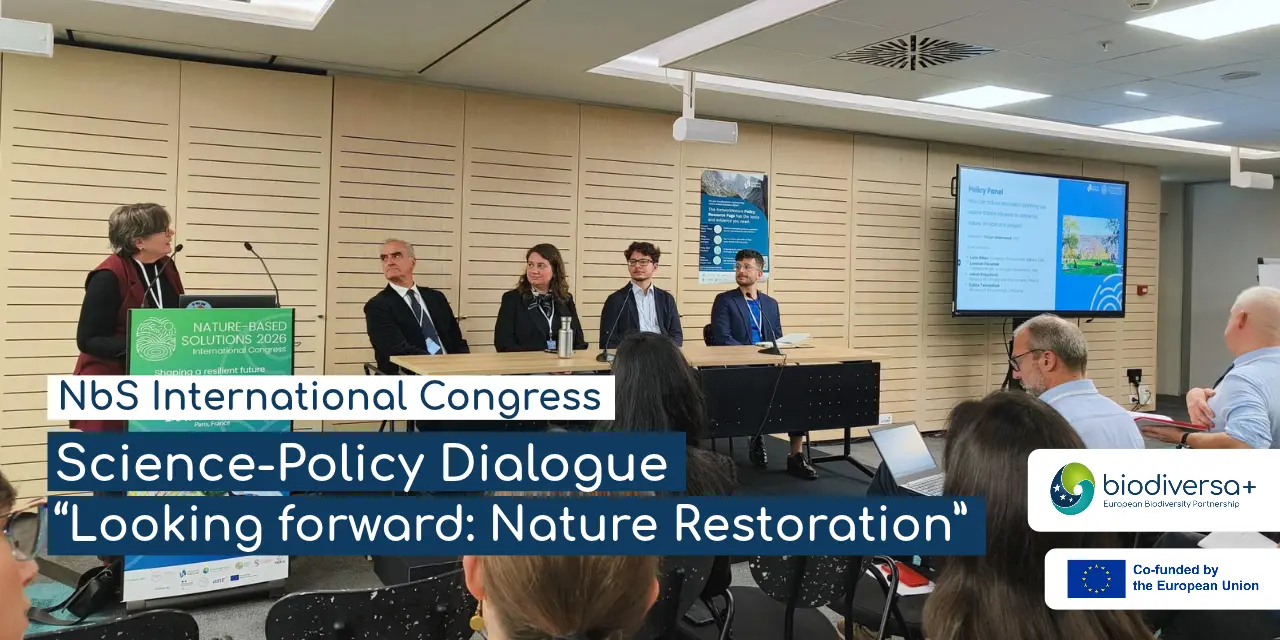
The Nature Restoration Regulation (NRR) aims to tackle biodiversity loss, climate adaptation and mitigation, and food security together. As Member States have recently submitted their draft National Restoration Plans (NRPs), the NetworkNature Science-Policy Dialogue “Looking Forward: Nature Restoration” (organised within the NbS International Congress – Paris, 2 November 2026) asked how Nature-based Solutions (NbS) can help deliver restoration that is ambitious, large-scale and lasting.
The afternoon was organised in three parts:
- Nature-based solutions in national restoration planning: ambitions and challenges – Italy, Poland and Lithuania presented concrete examples of methodologies, measures and challenges.
- Policy panel: how can nature restoration planning use NbS to deliver for nature, climate and people?
- Breakout sessions: small-group exchanges on financing restoration, restoration in cities, agriculture, indicators and metrics, sponge landscapes and marine restoration.
More than 100 policymakers, researchers, practitioners and financial actors discussed the main challenges and bottlenecks they face and shared experiences and good practices.
Restoration with multiple benefits
NbS work best when biodiversity, climate, water and livelihoods are designed in together from the start, with high integrity and a social and economic dimension. Across the national examples, the same ideas kept coming back: breaking silos, and moving from site-based approaches to landscape-scale thinking, with catchment-based coordination when it comes to water.
Engaging key sectors
Restoration depends on decisions made far beyond environment ministries. Speakers called for cross-ministry coordination and for the involvement of every level of government, from municipalities to national authorities. Practical lessons emerged:
- Combine top-down and bottom-up: policies should help bottom-up initiatives emerge, and identify and remove the barriers that block them, such as long permit procedures for actions landowners themselves want to take.
- Tailor the message: business, farmers and municipalities have different priorities, so the same goals need to be explained in different ways.
- Make the economic case: failing to restore means paying more for climate risks later, and socio-economic assessments can quantify the gains.
- Design incentives that work.
- Financing remains the open question.
Filling the gaps
The dialogue’s third question asked where the NbS research and innovation community can best support the delivery of NRPs. Several needs surfaced during the day:
- indicators and monitoring that track biodiversity and climate goals together, and the finance allocated to biodiversity
- capacity building for cities, municipalities and marine stakeholders
- stronger communication skills to explain NbS to different audiences
- governance that supports long-term vision rather than short-term decisions
The NRPs will be finalised by September 2027, leaving time to address these gaps. Success will depend less on new ideas than on implementation: cross-sector governance, landscape-scale planning, credible finance and genuine engagement with the people who live and work in these landscapes.
Read more: Biodiversa+ recently released eight policy briefs on nature restoration, to support Member States in implementing the Nature Restoration Regulation.