
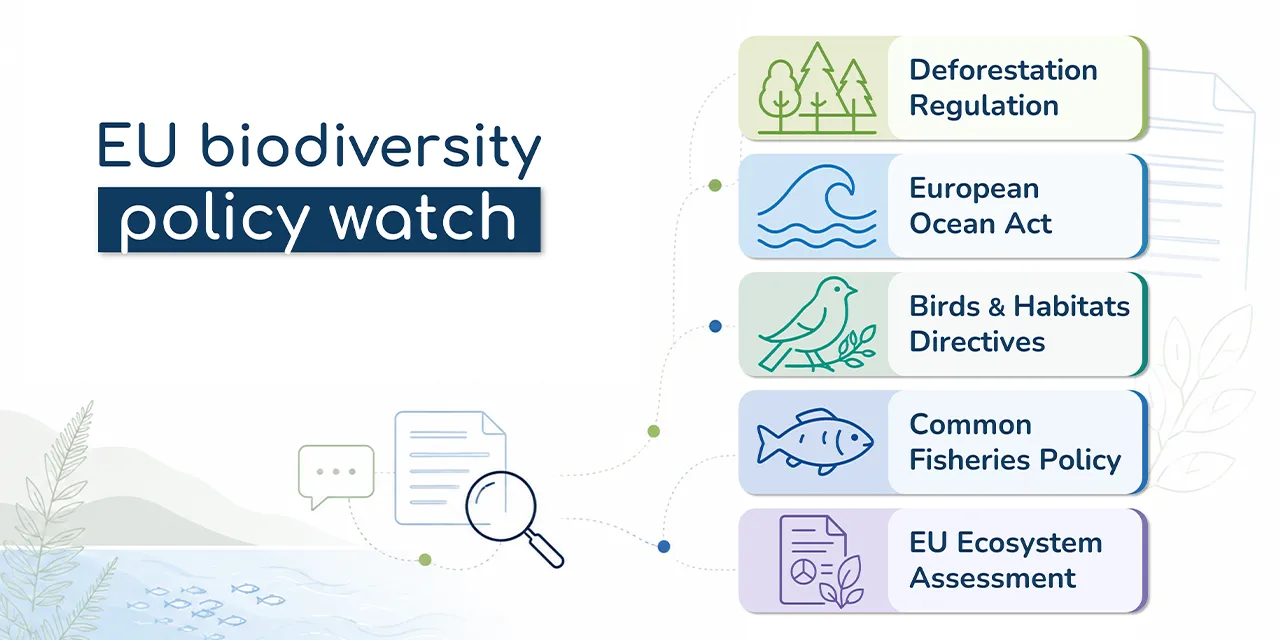
Several EU policy processes relevant to biodiversity are currently open for input, while others have recently reached an important evidence stage. Together, they touch on forests, oceans, fisheries, nature protection and the practical conditions needed to make environmental policy work.
Good biodiversity policy needs both ambition and strong evidence. Biodiversa+ encourages partners, funded projects and relevant experts to review the opportunities and resources below, and to contribute where their work can provide evidence or practical insights.
Open consultations and feedback opportunities
- EU Deforestation Regulation
The European Commission has opened a feedback period on proposed changes to the product scope, technical fixes and Annex I of the EU Deforestation Regulation. This consultation may be relevant for researchers and experts working on deforestation-free supply chains, traceability, land-use change, trade, commodities, forest degradation and biodiversity impacts linked to global value chains.
Open for feedback until: 1 June 2026
Consultation page: https://ec.europa.eu/info/law/better-regulation/have-your-say/initiatives/18053-Deforestation-proposal-to-amend-and-simplify-the-rules-and-make-technical-fixes-to-Annex-I_en
- European Ocean Act
The European Commission has opened a public consultation on the future European Ocean Act. The consultation covers future EU ocean governance, maritime spatial planning, ocean observation and the coordination of marine-related policies. It is particularly relevant for experts working on marine biodiversity, ocean monitoring, sea-basin governance, spatial planning, climate-biodiversity links, restoration and the sustainable use of marine space.
Open for feedback until: 16 July 2026
Consultation page: https://ec.europa.eu/info/law/better-regulation/have-your-say/initiatives/16238-European-Ocean-Act_en
- Birds and Habitats Directives stress test
The European Commission is also carrying out a stress test of the Birds and Habitats Directives, including a public consultation on their implementation, proportionality, administrative burden and fitness for purpose. This is an important opportunity for the research and conservation community to contribute evidence on how the Directives work in practice, including implementation challenges, monitoring and reporting needs, policy coherence, funding, stakeholder participation, species protection and site management.
Open for feedback until: 4 August 2026
Consultation page: https://ec.europa.eu/info/law/better-regulation/have-your-say/initiatives/18072-Birds-and-Habitats-Directives-stress-test/public-consultation_en
Recent policy and evidence updates to follow
- Evaluation of the Common Fisheries Policy Regulation
The European Commission has published its evaluation of the Common Fisheries Policy Regulation. The evaluation highlights important links between fisheries policy, marine biodiversity, ecosystem health, climate pressures and coastal communities. It also underlines the role of scientific evidence, data collection, monitoring and stakeholder engagement in supporting effective marine policy.
Evaluation document: https://ec.europa.eu/transparency/documents-register/detail?ref=SWD(2026)120&lang=en
- Towards the second EU Ecosystem Assessment
The Joint Research Centre has published a new report on the scientific and methodological approach for the second EU Ecosystem Assessment. It covers ecosystem condition, ecosystem services and drivers of change, and contributes to the evidence base needed for restoration priorities, biodiversity monitoring and EU biodiversity commitments.
JRC publication: https://publications.jrc.ec.europa.eu/repository/handle/JRC145950
- EU simplification agenda
The Commission’s wider simplification agenda provides useful context for several ongoing policy processes, including efforts to reduce administrative burden across EU policies. In biodiversity policy, simplification needs careful evidence. Reducing unnecessary administrative burden should not come at the expense of legal certainty, monitoring quality or nature protection outcomes. Evidence from researchers, practitioners and public authorities can help distinguish where procedures can be improved, and where safeguards remain essential.
Overview page: https://commission.europa.eu/law/law-making-process/better-regulation/simplification-implementation-and-enforcement/simplification_en