
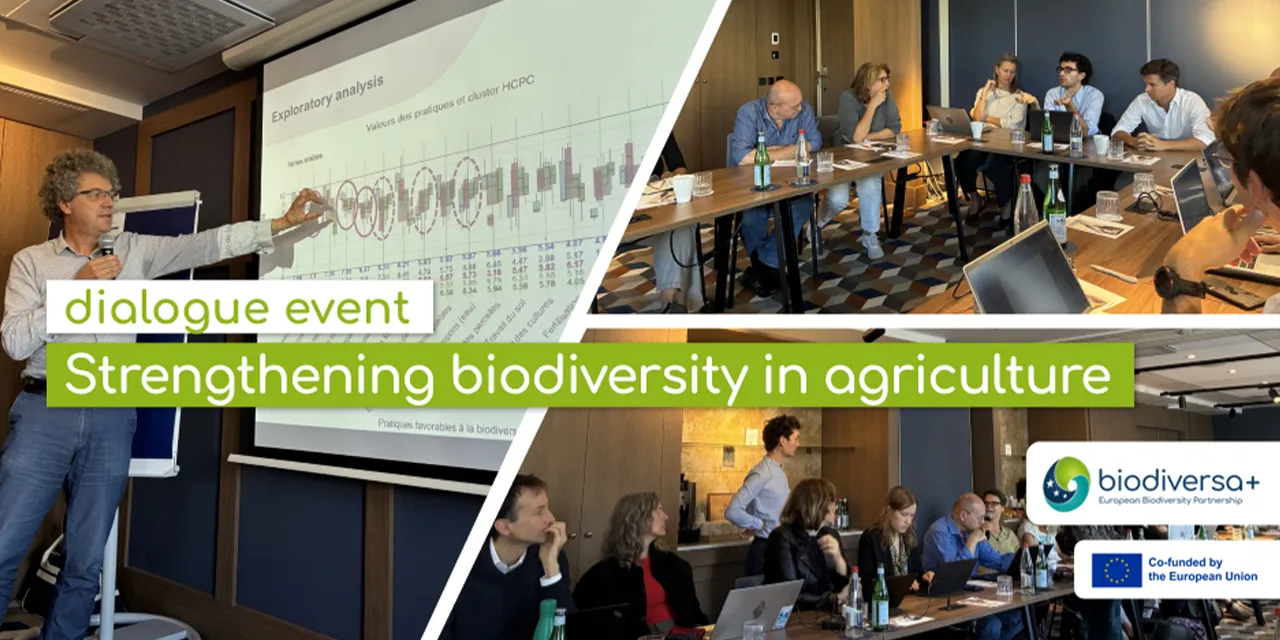
Biodiversa+ regularly organises dialogue events to bridge the gap between research and implementation. These events bring together policymakers, R&I programmers, experts, and stakeholders to identify emerging needs and priorities that could benefit from coordinated action in Europe. The most recent of these dialogues was held on 5-6 October 2026 in Paris to examine how agricultural policies could better support biodiversity, particularly under the Common Agricultural Policy (CAP).
While agriculture depends on biodiversity and ecosystem services such as pollination, pest regulation and soil fertility, it is also one of the main drivers of biodiversity loss. Farming systems need to reconcile these dependencies and pressures to support their long-term resilience. Ecosystem services offer a way to discuss benefits that matter directly to farmers, but indicators of these services do not capture every conservation objective, such as protecting threatened species or habitats. The dialogue explored the evidence and incentives needed to support biodiversity-enhancing agricultural measures, repeatedly highlighting a key challenge: ecological results often depend on more than the actions of individual farmers.
The European Commission’s Joint Research Centre and CAP evaluators introduced existing monitoring systems and the challenges of assessing policy impacts. Biodiversa-funded projects connected these issues to research on farmland habitats and farmer participation, providing examples of how hedgerows and flower strips can support biodiversity and pest regulation, as well as highlighting the importance of cooperation among farmers and incentives adapted to their needs and motivations. Group discussions followed to explore indicators, landscape approaches and payments for environmental services.
Several points stood out:
- Implementation, biodiversity outcomes and policy impacts are distinct questions. Recording that a farmer implemented a practice does not, by itself, demonstrate its ecological benefits; likewise, an observed improvement does not establish to what extent the policy contributed to it. Participants highlighted baselines, counterfactual comparisons and long-term field data as foundations for sound evaluation, while identifying monitoring costs, short-term funding and limited data access as obstacles. New technologies could open possibilities, provided they are validated for the relevant indicators and differences between methods are taken into account when combining data sources. Participants emphasised the continuing need for field monitoring and comparability over time.
- Results-based payments raise questions about risk and fairness. Ecological outcomes depend on factors that partly lie beyond farmers’ control (weather, neighbouring land management, etc.). Participants discussed schemes blending support for management commitments with rewards for ecological results. They also noted that differing starting conditions can complicate payment design, as maintaining a habitat and restoring degraded land can involve distinct costs and opportunities for improvement. The discussion highlighted the importance of understanding both the costs farmers incur and the income they may forgo when taking measures to support biodiversity.
- Payment schemes can interact with other instruments, with effects extending beyond the contract. This raised questions about how payments should work alongside regulation, certification and market incentives. Although consumer demand is considered a potential financing source, concerns remain about its reliability. Participants also discussed whether benefits would persist beyond the payment period and whether reducing pressures on supported land could lead to intensification elsewhere.
- Ecological and economic timescales can be difficult to reconcile. Biodiversity responses may take years to become apparent, while farmers face more immediate financial constraints and support schemes operate within limited funding periods. This mismatch complicates both the design of incentives and the assessment of their effects.
- The effectiveness of a practice depends on local conditions and the scale of action. Participants questioned the usefulness of a universal ranking of biodiversity-enhancing practices, noting that broad spatial assessments can lose relevance to local conditions. They discussed identifying priorities at regional or landscape level instead. Collective incentives could foster coordination where outcomes depend on actions taken by multiple land managers. Cooperation, however, also presents challenges, such as disagreements and uneven contributions. Participants discussed advisers and facilitators as potential ways to help farmers connect individual commitments with shared objectives.
- Farmer participation encompasses both influence over design and responsibility for implementation. Farmers’ knowledge, motivations and constraints can help shape more effective approaches, but meaningful involvement requires time and support. Views differed on the role farmers should play in monitoring, given the training, funding and workload involved. Farmer advisers were discussed as a possible source of support for data collection, with some participants also highlighting the value of independent monitoring. Participants emphasised the need to share research findings on indicators and policy evaluation with farmers.
These discussions exposed a need for clearer definitions of what schemes support and how delivery is assessed. They also identified knowledge needs concerning indicator reliability, policy evaluation and the design of fair and effective incentives. These insights will help Biodiversa+ refine research priorities and strengthen exchanges between science and policy in support of biodiversity and resilient agricultural systems.