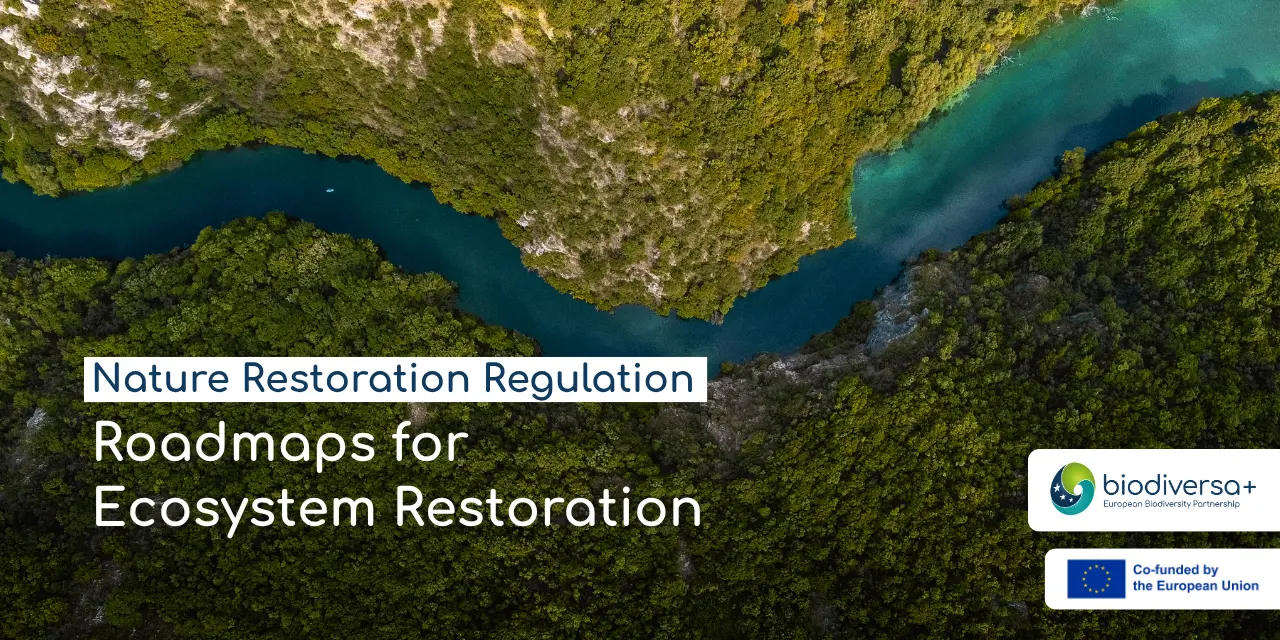
With the incoming implementation of the Nature Restoration Regulation (NRR), nature restoration in Europe is now entering a critical phase. Forests, rivers, coasts and cities are all connected, and successful restoration depends on understanding how. Our series of four Ecosystem Roadmaps explores how to restore water across marine, freshwater, urban and forest ecosystems, translating the latest European research into practical guidance for National Restoration Plans (NRPs).
They provide phased guidance tied directly to the articles of the NRR and the requirements of the NRPs themselves, giving Member States concrete, evidence-based pathways to translate NRR ambitions into lasting ecological recovery.
The briefs cover the full NRPs timeline:
- the 2026-2028 window: preparation, review and early implementation;
- the 2030 milestone: delivery and assessment of first major restoration targets;
- the 2040–2050 horizon: review, revision and progress toward long-term targets.
Explore the four Ecosystem Roadmaps and their recommendations.
Biodiversity-climate-water nexus
Restoring forests is not only about biodiversity. Healthy forests support climate resilience, water regulation and freshwater ecosystems, making them a clear example of the biodiversity–climate–water nexus. Effective restoration requires integrated planning that accounts for climate risks, ecological connectivity and the interactions between forest and freshwater systems.
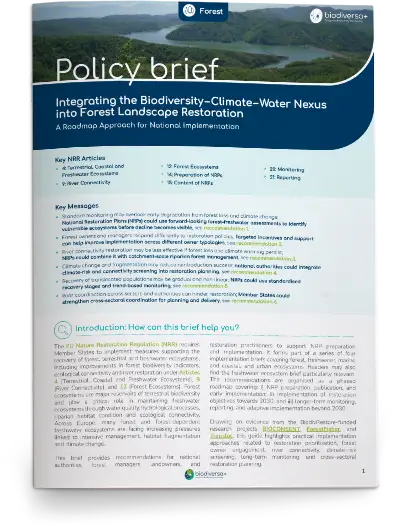
Main recommendations:
- Restore more than forest cover alone. Develop forward-looking forest-freshwater assessments that plan forests and freshwater systems together, supporting biodiversity, water systems, and climate resilience.
- Select restoration sites and species based on long-term habitat suitability and connectivity, incorporating climate-risk screening for species reintroductions to ensure decisions hold under future conditions.
- Monitor ecological recovery over the long term through catchment-scale riparian restoration approaches and adaptive management, adjusting as conditions change.
Marine and coastal restoration
Marine restoration requires careful planning to deliver lasting ecological recovery. It is costly, technically demanding, slow to show results, and remains significantly underfunded and under-planned relative to terrestrial restoration. With limited resources and rapidly changing oceans, the priority question for Member States is where to restore.
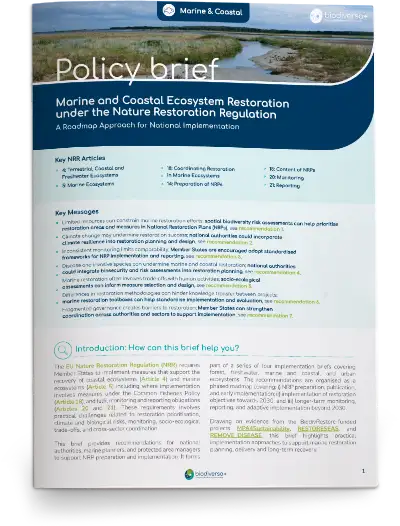
Main recommendations:
- Restore where nature is most likely to recover, using spatial risk mapping and scientific prioritisation.
- Plan by integrating climate resilience screening into restoration design from the outset.
- Monitor restoration through standardised frameworks that enable adaptive management and improve long-term success.
- Coordinate restoration across sectors, authorities, and borders.
Resilient urban waters
Urban rivers, ponds and wetlands can simultaneously support biodiversity, improve water quality, regulate flooding and strengthen climate resilience when managed as functioning ecosystems rather than simply as drainage infrastructure. Climate change and urbanisation are increasing pressures on urban freshwater systems. Addressing these interconnected challenges requires moving beyond purely engineered responses.
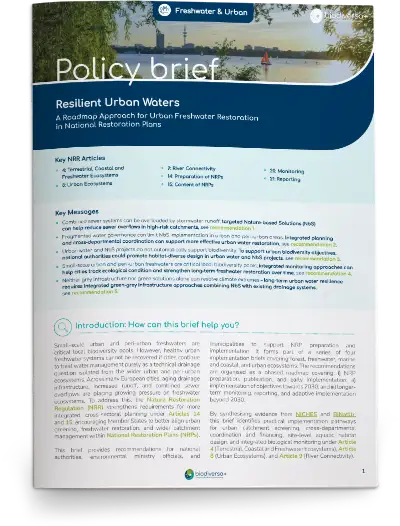
Main recommendations:
- Design urban waterways for biodiversity, not just drainage, creating diverse aquatic habitats that support ecological quality alongside water management functions.
- Plan water management across the whole city, integrating water governance, biodiversity, and urban planning at catchment scale.
- Use Nature-based Solutions where they can make the biggest difference, focusing on flood hotspots and combined sewer overflow areas.
Freshwater restoration
Healthy freshwater ecosystems depend on connected river systems. Restoring rivers, lakes, and wetlands is most effective when planned across the whole catchment rather than at isolated sites. Everything that happens upstream, from water quality and sediment flows to land use and habitat connectivity, shapes what is possible downstream. Water quality, habitat fragmentation, hydrology, and land use all interact at river basin scale.
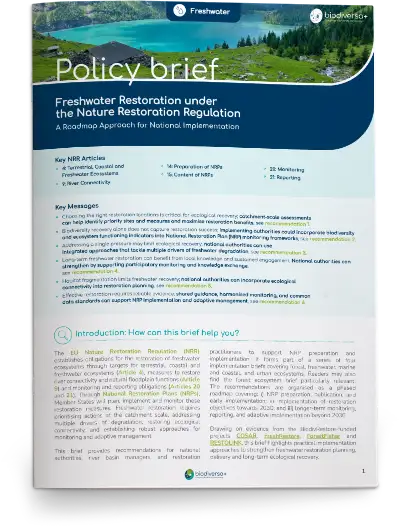
Main recommendations:
- Restore at catchment scale, prioritising where recovery potential is greatest and addressing habitat, hydrology and water quality together for lasting ecological recovery.
- Strengthen ecological connectivity across freshwater systems to support species movement and resilient habitat networks that can withstand future pressures.
- Monitor restoration through standardised protocols, shared frameworks, and technical guidance, enabling adaptive management of restoration outcomes.
Those four briefs are part of a Biodiversa+ Policy Briefs series on the Nature Restoration Regulation, supporting EU Member States as they face challenges in the establishment of national strategies and action plans on nature restoration.