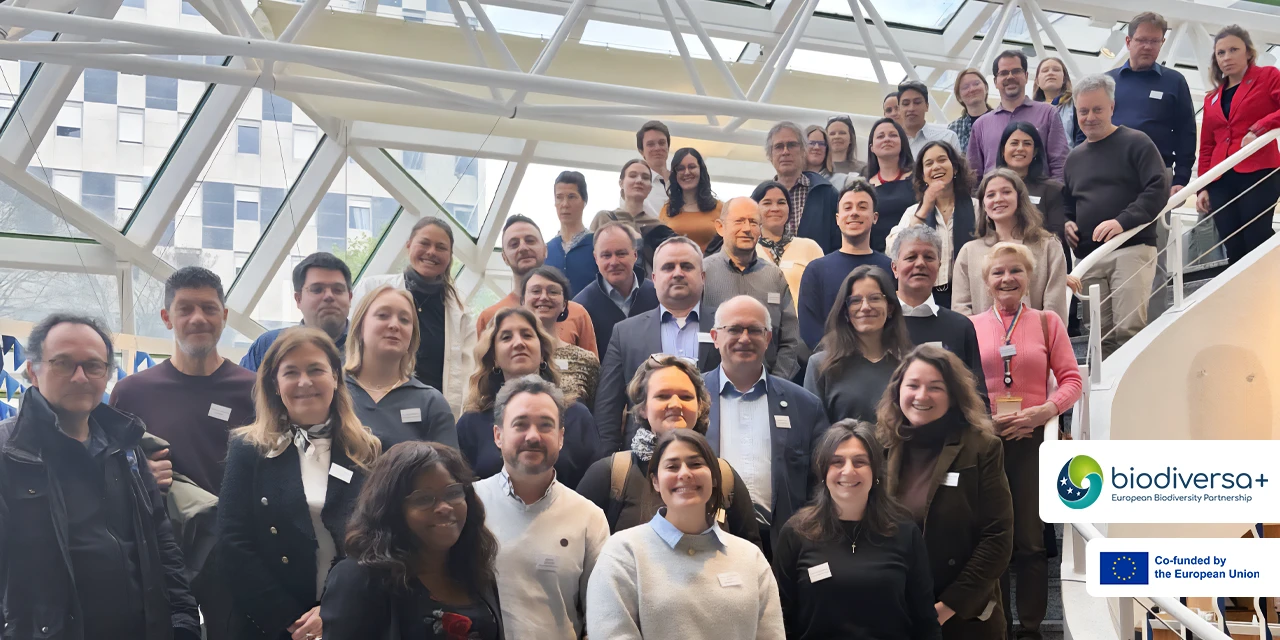
From 23 to 26 March 2026, members of Biodiversa+’s Enlarged Stakeholder Board (ESB) and Advisory Board (AB) met to discuss the Partnership’s activities and its future.
These boards play a key role in Biodiversa+: they bring external perspectives from science, policy, business and civil society, helping to challenge assumptions, identify gaps, and guide strategic choices. At a time when the Partnership is preparing for its future beyond the current Horizon Europe framework, their inputs is particularly critical.
Informing strategy at a turning point
A central focus of the discussions was Biodiversa+’s transition strategy. With EU co-funding expected to evolve after 2027, the Partnership is exploring how to sustain its activities while maintaining its core mission, with questions around funding models and long-term positioning at the forefront. Exchanges with ESB and AB members helped clarify key questions, such as which functions Biodiversa+ should preserve, where it brings the most added value at European level, and how it can remain relevant in an increasingly complex landscape of initiatives.
Across discussions, there was strong support for maintaining Biodiversa+’s role as a platform connecting research, policy and practice, while being more explicit about its strategic focus and priorities. These discussions also helped highlight where Biodiversa+ should focus its efforts in the coming years.
From knowledge to uptake
A recurring theme was the need to strengthen knowledge uptake. Participants pointed out that the challenge is often not the lack of knowledge, but the difficulty of making it usable in practice, beyond reports and academic outputs, and across different audiences such as policymakers, practitioners, and businesses. Several participants also highlighted the time and effort required to identify, understand and adapt existing materials to their own contexts.
This has concrete implications for how Biodiversa+ designs and shares its outputs. These include developing formats that are easier to use and adapt, such as policy briefs, case studies or short summaries, working more closely with intermediaries and practitioners, and focusing on formats that support application, not only dissemination. These reflections are directly informing upcoming activities, including the Biodiversa+ Dialogue event in May, which will focus on how research results can translate into impact in practice.
Strengthening biodiversity monitoring
Monitoring remains one of Biodiversa+’s core areas of work. Discussions highlighted both the scale and fragmentation of existing monitoring efforts across Europe, across countries, ecosystems and monitoring approaches, as well as the need to better connect and synthesise them. The development of BioDash was presented as one response to this challenge. It aims to improve access to information on monitoring schemes, support decision-making, for example by helping identify where data is missing or uneven across regions, and highlight priority gaps.
More broadly, exchanges confirmed that Biodiversa+ has a key role to play in structuring and supporting monitoring at European level, particularly by helping connect existing efforts and make them more usable. Still, questions remain about long-term sustainability and coordination across initiatives.
Engaging with business
Business engagement was another key topic. Biodiversa+ is currently developing a strategy to better connect biodiversity research with business needs, including areas such as data use, risk assessment, and nature-based solutions, for example to support decision-making in sectors such as finance or land use. Discussions highlighted both opportunities and challenges, in particular the difficulty of aligning research outputs with business needs and expectations, and the importance of avoiding duplication with existing initiatives.
There was broad agreement that Biodiversa+ can play a role as a facilitator, particularly by connecting actors and providing relevant knowledge. However, this requires targeted and realistic approaches at this stage.
Looking ahead
The meetings provided valuable input at a key moment for Biodiversa+, helping to clarify priorities and identify areas where activities can be strengthened. They also reinforced the importance of working across communities.
In the coming months, this input will feed into the further development of the transition strategy, as well as a range of upcoming activities and exchanges. It will also inform ongoing work on business engagement, monitoring and communication. Continued engagement with partners and stakeholders will be essential as Biodiversa+ defines its role and direction for the years ahead.