
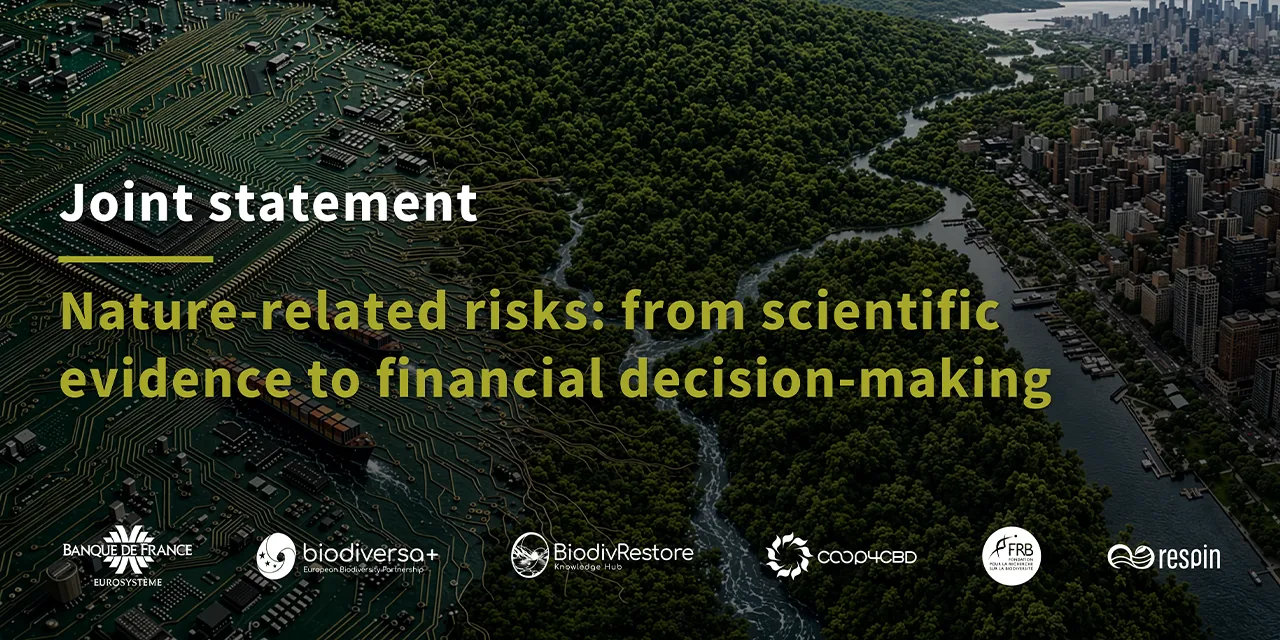
A joint statement by Banque de France, Biodiversa+, the BiodivRestore Knowledge Hub, CO-OP4CBD, the French Foundation for Biodiversity Research, and RESPIN following the workshop Toward Nature-Positive Finance: Scientific Foundations for Action.
Biodiversity is declining at an unprecedented rate.
According to IPBES, 14 out of 18 categories of ecosystem services are in decline, including water regulation, pollination, soil fertility and carbon sequestration1. These trends reflect a systemic degradation of the natural systems that underpin human well-being and economic activity and can no longer be addressed as a marginal environmental issue.
This evidence from climate and nature science translates into economic and financial concerns. While produced capital has expanded over recent decades, natural capital has continued to decline, a trend insufficiently reflected in current economic metrics2. Economic activities and financial systems are fundamentally dependent on nature and its contributions to people. More than half of global GDP3 (around USD 44 trillion) directly depends on ecosystem services. As increasingly recognised by central banks and supervisors, including within the Network for Greening the Financial System (NGFS), continued nature degradation is likely to translate into material financial risks affecting business models, asset values and, ultimately, financial stability.
At the same time, global financial flows remain structurally misaligned with biodiversity objectives. Financial flows with direct negative impacts on nature are estimated at around USD 7.3 trillion annually, compared to approximately USD 200–220 billion directed toward activities that restore and protect biodiversity4. This imbalance underscores the need to move beyond risk awareness toward risk preparedness, and to integrate nature-related dependencies, impacts and risks more systematically into financial decision-making processes.
From risk awareness to risk preparedness
In this context, the workshop “Toward Nature-Positive Finance”5 highlights that addressing naturerelated risks requires a shift from fragmented approaches to a systemic perspective. Building on the recent findings of the IPBES Business and Biodiversity Assessment6, it emphasizes that pressures on nature arise along a continuum of corporate decisions, spanning from strategic governance to business operations. The workshop also points to emerging responses at these different levels. It also underscores the role of an enabling environment in supporting this transition. Financial regulation, alongside market incentives and disclosure practices, plays a decisive role in shaping this environment and strengthening the capacities needed to assess and manage nature-related risks, while enabling the alignment of financial flows with the objectives of the Kunming–Montreal Global Biodiversity Framework.
Scientific knowledge is crucial to this transition. It documents biodiversity loss and associated risks and provides the guidance and tools needed to better assess these risks. It also informs economic and financial decision-making. By engaging with available scientific knowledge and expertise, financial institutions and businesses can strengthen the robustness of their decisions and take action. However, significant gaps remain: scientific knowledge is not always readily accessible or operational for financial and business actors, biodiversity data remain fragmented, and methodologies to assess dependencies, impacts and risks, including valuation approaches, continue to evolve. Strengthening interfaces between science, policy, business and finance is therefore critical to ensure that existing data and knowledge effectively inform action, thereby supporting the integration of biodiversity across economic and financial decision-making (mainstreaming).
More broadly, transformative change depends on aligning enabling conditions. As highlighted by the IPBES assessment, it requires policy and legal frameworks, economic and financial systems, social norms, technological infrastructure, and knowledge and skills to evolve together in a coherent way. Within their respective mandates, public authorities can play a key role in shaping these conditions. Governments, central banks, supervisors and public financial institutions can strengthen institutional and analytical capacities, enhance risk assessment frameworks, advance disclosure practices, and foster international cooperation. Evidence from environmental and economic science fully contributes to the design and improvement of robust financial instruments that support the transition.
Shared recognition
This joint statement reflects a shared recognition that nature-related risks pose a material and systemic challenge to economic and financial systems. In this context, inaction is not neutral: delaying the integration of nature-related risks into financial systems will increase their materiality and potential systemic impacts. Addressing them requires both the continued strengthening and mobilisation of scientific knowledge, and coordinated action to align incentives, institutions and financial flows with the objectives of the Kunming–Montreal Global Biodiversity Framework.





1 Global Assessment Report on Biodiversity and Ecosystem Services (IPBES, 2019)
2 The Economics of Biodiversity: The Dasgupta Review (HM Treasury, 2021)
3 Nature Risk Rising: Why the Crisis Engulfing Nature Matters for Business and the Economy (World Economic Forum, 2020)
4 State of Finance for Nature 2023: The Big Nature Turnaround (United Nations Environment Programme, 2023)
5 Nature-positive finance refers to financial systems and decisions that integrate nature-related risks and dependencies, and actively contribute to halting and reversing biodiversity loss in line with global biodiversity goals
6 Methodological assessment of the impact and dependency of business on biodiversity and nature’s contributions to people (IPBES, 2026)