This summer, Biodiversa+ looks back at research projects supported through its predecessor, BiodivERsA, exploring how scientific collaboration has contributed to policy, practice and innovation. Each story highlights what changed, how researchers worked with stakeholders, and what future projects can learn from their experience.
In river valleys across Europe, a small amphibian was quietly reshaping ecosystems: the African clawed frog. The INVAXEN project (INVAsive biology of XENopus laevis in Europe: ecology, impact and predictive models) set out to understand how, and how far it had spread, tracking the African clawed frog’s movements, adaptations, and effects on native wildlife across several countries.
What researchers learned didn’t stay in the lab: it fed directly into new policies and conservation measures aimed at containing the species’ spread. In one area in Portugal, the right conditions even made full eradication possible.
Today, the project’s approach continues to inform how scientists detect and respond to invasive species.
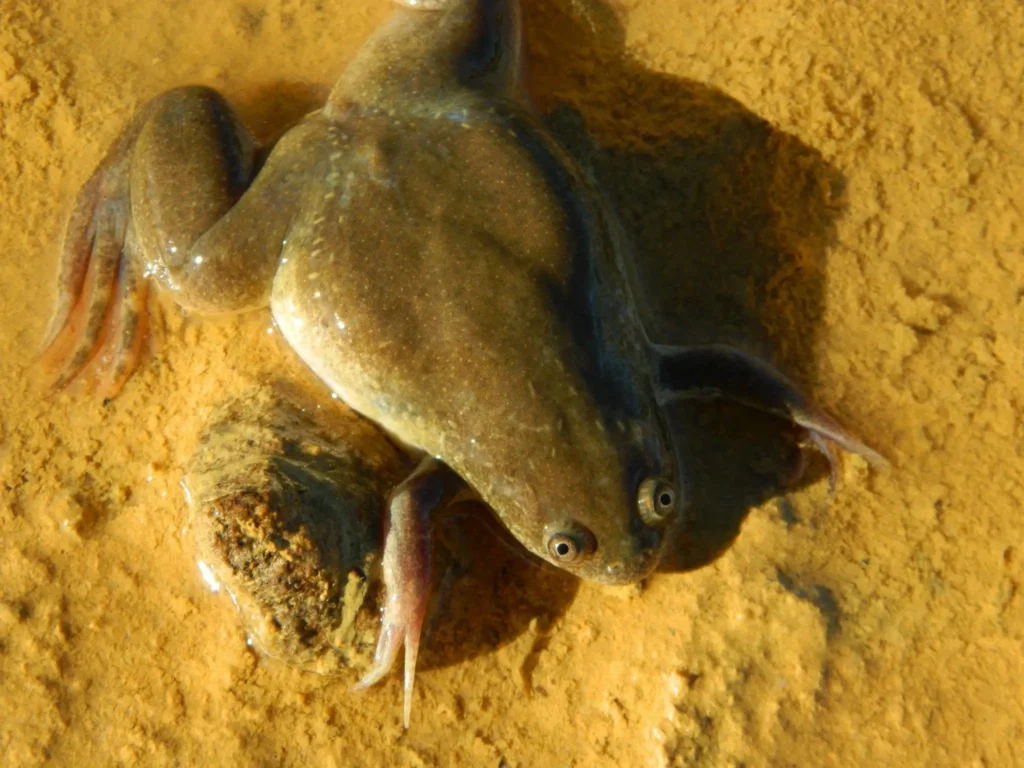
- Invasive species studied: Xenopus laevis
- European invasion sites: France, Portugal, Italy, United Kingdom
- Research focus: adaptation, dispersal, ecological impacts on new ecosystems, competition for food resources, physiological traits
- Outcomes: movements modelling and spread prediction, to support preventive measures
Invasive species pose a significant threat to global biodiversity, and among them, Xenopus laevis, the African clawed frog – most often escaped or deliberately released from laboratory stocks – has emerged as a concern in several European countries. Its story began far from home: once a staple of biomedical research, this amphibian is now rewriting the ecological balance of the regions it invades.
Climate conditions are favourable for this species across a huge area in Europe, making its expansion a serious threath. Invasive Xenopus laevis impacts native amphibians and fish, competing with them for resources, and can transmit diseases such as chytridiomycosis, one of the principal causes of the global decline in amphibians.
The INVAXEN project, funded by the BiodivERsA program, was designed to study the biology, spread, and ecological impact of this amphibian, and evaluate its invasive potential.
But understanding a threat is only the first step. The project went further than that.
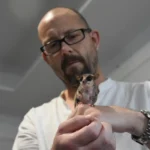
“We studied the dispersion of the species, its mobility, and its dependence on factors such as temperature, climate conditions, and landscape connectivity.”
Anthony Herrel, project leader
Through extensive scientific research and international collaboration, INVAXEN has not only expanded knowledge of Xenopus laevis but has also had direct implications for biodiversity policy and management. From European directives down to local decrees, legislations now include measures to control Xenopus laevis populations and preserve native biodiversity.
Thanks to the collaboration with land owners and environmental services, the invasive species was completely eradicated in one area in Portugal.
Influencing EU policy
Influencing EU policy
One of INVAXEN’s major contributions was providing scientific evidence that led to the classification of Xenopus laevis as an invasive species of concern by the European Union.
This designation resulted in the prohibition of its sale in Europe.
Influencing local policy
Influencing local policy
The project inspired the LIFE CROAA program in France specifically aimed at controlling Xenopus laevis populations and preserving biodiversity.
The data collected played a crucial role in shaping these decisions, particularly an impact assessment conducted by John Measey, key researcher.
Engaging the public & media
Engaging public & media
INVAXEN emphasised the importance of public awareness. Several articles were published in mainstream media to educate the public on the dangers of invasive species. A dedicated awareness campaign was launched within the framework of the LIFE project to further engage communities in conservation efforts.
Controlling the species
Controlling the species
The species was eradicated in one valley in Portugal due to favorable geographical conditions. In France, it is already too widespread to eradicate. Monitoring programs help detect any further spread and mitigate its impact, while improving natural habitats supports native biodiversity and reduce the advantage of Xenopus laevis.
Future strategies: the role of technology in invasive species management
One of the key lessons from INVAXEN is the importance of early detection. To enhance surveillance, researchers are now developing artificial intelligence tools capable of analysing images from drones and environmental monitoring cameras to identify invasive species in real time.
“Prevention remains the best strategy,” says Anthony Herrel. “Once an invasive species is established, eradication becomes nearly impossible.” The use of AI-driven monitoring tools could revolutionise the management of invasive species, allowing for quicker responses and more effective containment measures.
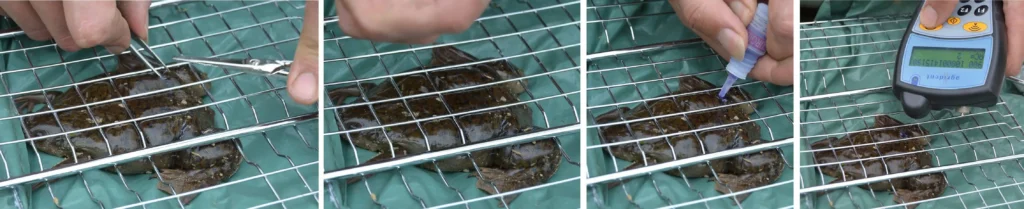
Marking of an adult specimen of Xenopus laevis. While the frog is fixated, a tiny ID transponder is carefully inserted subcutaneous. The small cut is subsequently closed using veterinary glue. Photo by J. Courant
A model for future research and conservation efforts
INVAXEN has not only advanced scientific understanding of Xenopus laevis, but also set a precedent for integrating ecological data into risk models for invasive species management. “Before, predictive models did not fully account for species’ physiological traits and adaptive capacities,” Herrel explains. “Our work has shown how crucial it is to incorporate these factors.”
The methodological framework developed through INVAXEN is now being used as a reference for other research projects on invasive species. By combining field data, ecological modeling, and physiological studies, the project has contributed to a more comprehensive approach to species invasion management.