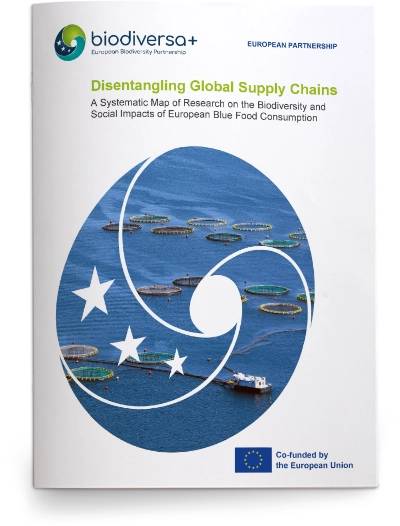
Knowledge synthesis: “Disentangling Global Supply Chains: A Systematic Map of Research on the Biodiversity and Social Impacts of European Blue Food Consumption”
Published: May 2026 | 10.5281/zenodo.20399218
Blue foods are often discussed as part of more sustainable food futures. Understanding their impacts requires looking beyond what is consumed in Europe, and beyond the farm site itself. This systematic map examines how research has studied the biodiversity and social impacts of European blue food production-consumption chains. It focuses on four groups of farmed marine fish that are relevant to European markets: cod, salmon, sea bass and gilthead sea bream. It maps where evidence is concentrated, and where important gaps remain.
At a glance
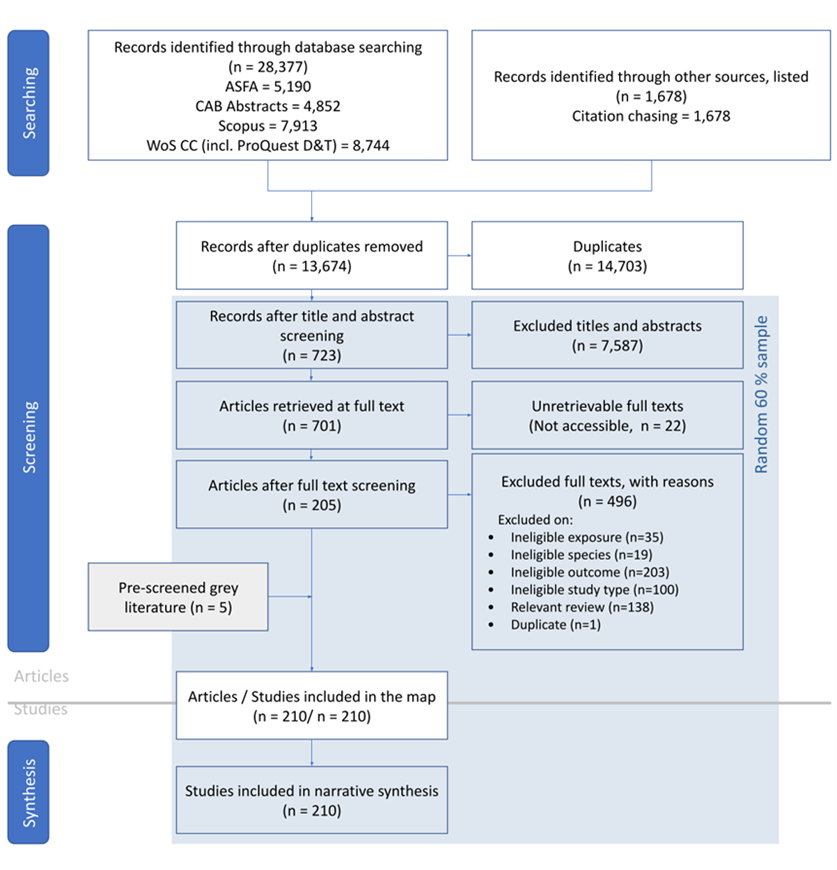
- The systematic map includes 210 relevant studies, identified by screening a random 60% subsample of more than 28,000 search results.
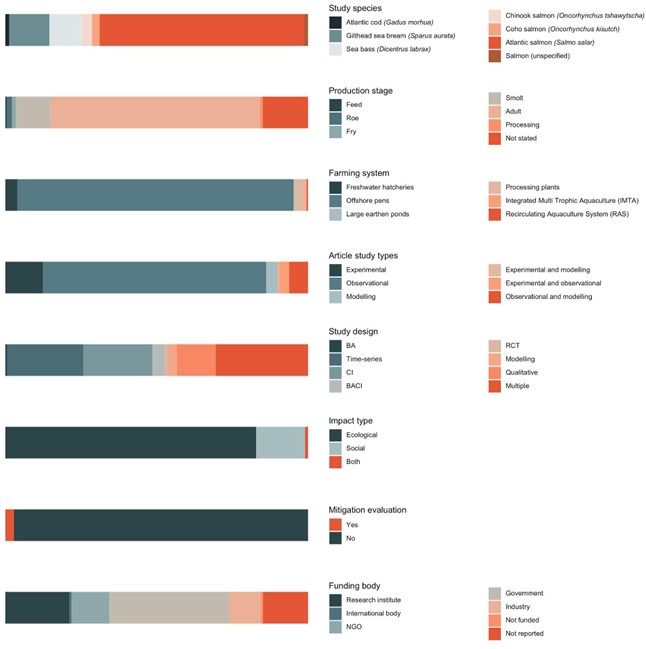
- Research is highly concentrated on Atlantic salmon, selected major producing regions, ecological impacts and adult fish rearing in offshore pens.
- Several ecological impact areas are relatively well represented, including impacts on benthic communities, wild fish interactions, pathogens, sea lice and organic pollution pathways.
- Social impacts are much less studied. Key dimensions such as labour conditions, food security and food sovereignty in producing regions are largely absent from the mapped evidence base.
- Feed production, hatcheries and early life stages, processing and post-harvest activities remain much less studied than farm-level grow-out.
- Very few studies assess mitigation measures or examine both social and ecological outcomes, limiting the evidence available for integrated policy responses.
What did the study look at?
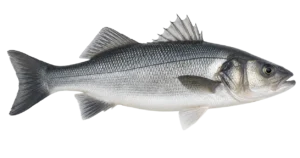
The study examined research on the biodiversity and social impacts of European blue food production-consumption chains, with a focus on four groups of farmed marine fish:
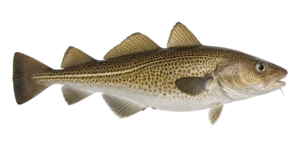
Cod
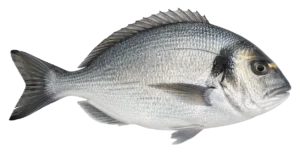
Gilthead sea bream
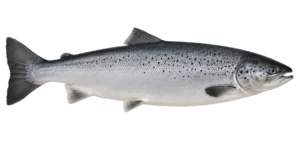
Salmon
Sea bass
The review considered global social and ecological systems, including aquaculture and fisheries in countries that export marine-derived foods to European markets. It also included research on fish feed impacts where those impacts were explicitly connected to the species covered by the study. Shellfish were outside the scope of the review, as they involve different culture methods and inputs.
The systematic map followed established evidence synthesis standards and was conducted according to an a priori protocol. The authors searched five bibliographic databases, complemented by grey literature searches, and screened records at title, abstract and full-text level. Due to the size of the evidence base and available resources, the review used a random subsampling approach, with 60% of the evidence examined in total.
The review used a modified PICO framework, considering social and ecological systems as the population, aquaculture as the exposure, and any social or biodiversity outcome as the outcome of interest. The authors extracted information on species, geography, production stage, farming system, impact type, study design, study length and funding source.
Because the study is a systematic map, it did not include a formal critical appraisal of the quality of individual studies. Its purpose is therefore not to provide a full sustainability assessment of blue food systems, but to show how the research evidence is distributed.
Where is the evidence most concentrated?
Several ecological impact areas are relatively well represented, particularly in relation to salmon farming and offshore pen systems.
- Atlantic salmon dominates the evidence base
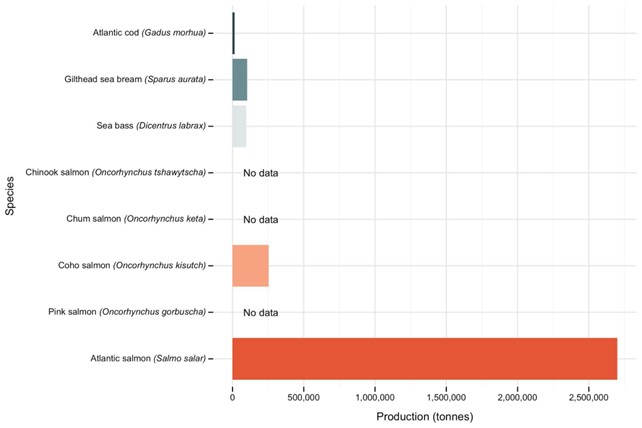
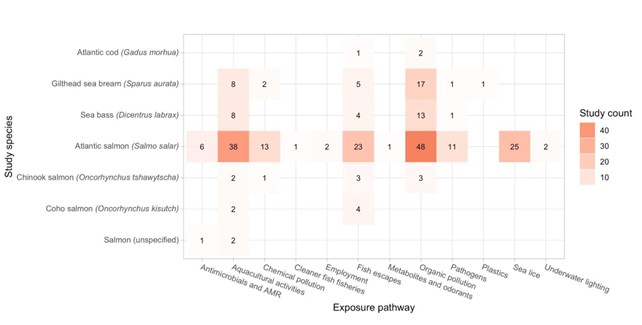
Atlantic salmon dominates the evidence base, with studies concentrated in major producing regions such as Canada, Chile, Norway, and the UK. Sea bass and gilthead sea bream are also covered, mainly in Mediterranean countries, while cod receives little attention. This pattern reflects the scale of salmon aquaculture but skews evidence toward a single species, production model, and limited set of regions.
- Ecological impacts are much better covered than social impacts
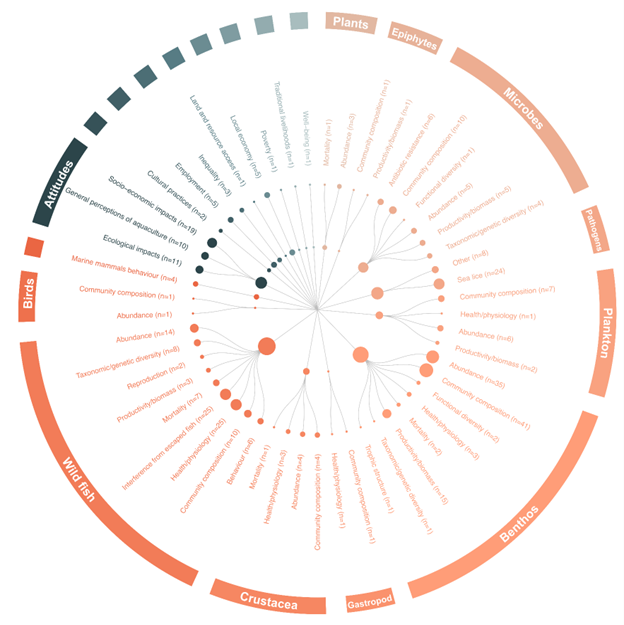
Most mapped studies focus on ecological outcomes, particularly benthic communities, wild fish interactions, pathogens, sea lice, and organic pollution pathways. Strong clusters of research address benthic community composition and abundance, as well as wild fish health, mortality, and interactions with escaped farmed fish, with sea lice and pathogen impacts especially prominent in salmon systems. These clusters suggest parts of the evidence base may be mature enough for more targeted synthesis.

- Research focuses mainly on adult fish rearing in offshore pens
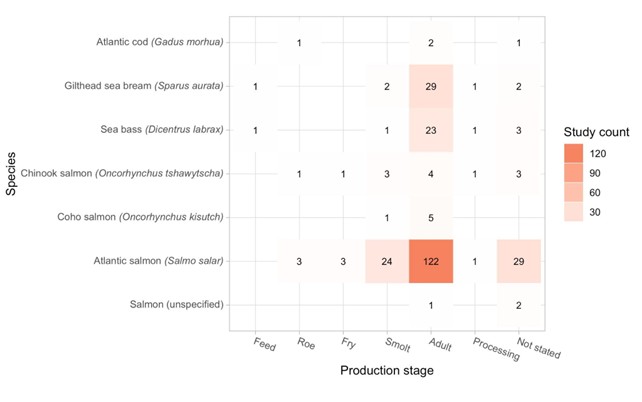
Most studies focus on the adult grow-out stage in marine pens, where ecological pressures are most visible and monitoring more accessible. However, this narrows the scope, leaving the evidence base far stronger for farm-level ecological impacts than for broader supply-chain impacts linked to European consumption.
Where does the evidence remain limited?
Several dimensions remain under-studied, even though they are highly relevant to sustainable and equitable blue food systems.

- Social impacts and social-ecological links remain underrepresented
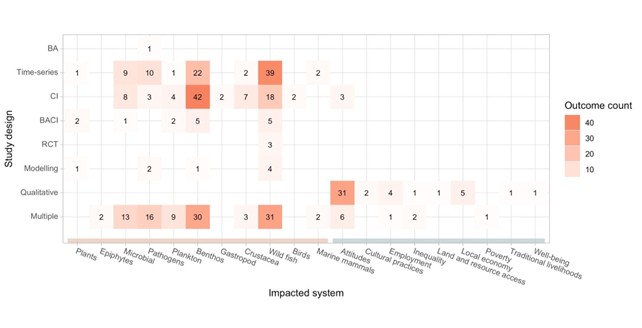
Social impacts remain far less studied than ecological ones. The mapped evidence base reveals significant gaps across several key dimensions, including land and resource access, labour conditions, food security, and food sovereignty in producing regions. It also highlights a striking lack of integration between social and ecological perspectives, with only a single study addressing both types of outcomes. Future research could help elucidate how ecological impacts translate into social consequences, how costs and benefits are distributed, and where trade-offs and cascading effects arise along supply chains.

- Supply-chain stages beyond grow-out are poorly covered
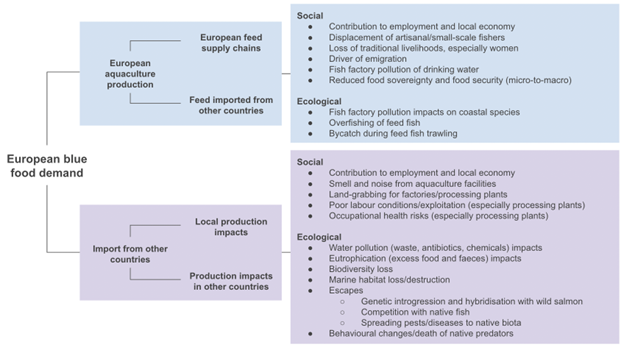
Most studies focus on adult rearing in offshore pens, with far less attention to upstream and downstream stages such as feed production, hatcheries and early life stages, and post-harvest processing. This limits understanding of European blue food production-consumption chains, particularly as feed supply chains can link aquaculture to ecological and social pressures in other regions.

- Mitigation measures are rarely evaluated
Only six studies in the map examine mitigation measures. Most relate to sea lice management or recovery after farm closure. Only one study is considered potentially related to a nature-based solution, through Integrated Multi-Trophic Aquaculture. More evidence on mitigation would help assess which interventions reduce impacts, under what conditions, and whether they create new trade-offs.

- Study designs also limit interpretation
The map also highlights methodological limitations. Many studies are relatively short compared with aquaculture production timescales. There is limited use of study designs such as Before-After-Control-Impact approaches. This means that, even where evidence exists, further work may be needed to strengthen causal understanding and support robust decision-making.
Towards a fuller picture of blue food impacts
This systematic map supports Biodiversa+’s role in connecting research evidence to policy needs. By showing where evidence is concentrated and where it remains limited, it helps distinguish between areas where further synthesis may already be possible and areas where new research is still needed.
In some areas, evidence clusters may already be suitable for more focused synthesis. These include benthic and microbial impacts of salmon farming, wild fish interactions, organic pollution, sea lice and social attitudes in specific producing regions. Such synthesis could help move from mapping where evidence exists to assessing what the evidence shows.
In other areas, the report points to the need for new and more integrated research, particularly on social impacts, supply-chain stages beyond grow-out, mitigation measures and studies that connect ecological and social outcomes.
Together, these findings make the map a useful starting point for more focused research and policy discussions. It helps clarify what evidence is already available to inform debates on European blue food consumption, and where further research or synthesis is still needed.