
Other languages
These translations are provided for information purposes. In the event of any discrepancy, please refer to the original English version.
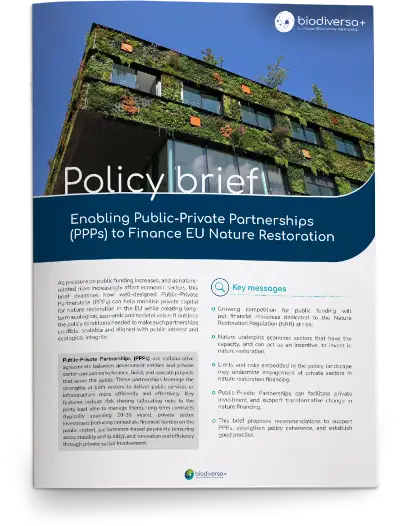
Policy Brief: “Enabling Public-Private Partnerships (PPPs) to Finance EU Nature Restoration”
Published: June 2026 | DOI: 10.5281/zenodo.21360186
Public-Private Partnerships (PPPs) are collaborative agreements between government entities and private sector companies to finance, build, and operate projects that serve the public. As pressure on public funding increases, and as nature-related risks affect a growing number of economic sectors, well-designed PPPs offer a way to mobilise private capital for nature restoration while generating long-term ecological, economic and societal value. This Policy Brief examines the conditions needed to make such partnerships credible, scalable, and aligned with public interest and ecological integrity.
The brief proposes concrete recommendations to support high-integrity PPPs, strengthen policy coherence, and establish good practice, illustrated by four case-studies (MERLIN, Peatland Finance Ireland, REST-COAST, and River Stewardship Company).
This brief emerged from the BiodivRestore Knowledge Hub, a network of researchers and stakeholders collaborating to empower countries in developing and implementing National Restoration Plans. It is part of a series of eight briefs about Nature Restoration. It addresses a challenge shared across Member States: the current financing landscape is not favourable to nature restoration. By exploring how PPPs can help close this gap, the brief contributes to advancing the implementation of the Nature Restoration Regulation.
Key messages:
- Economic sectors are structurally dependent on nature: in the EU, 72% of non-financial corporations and nearly 75% of Euro-area bank loans are linked to sectors with high or moderate dependency on nature. As nature’s degradation poses a material risk to businesses, engaging the private sector in restoration is not just a matter of philanthropy, but also an economic necessity.
- Private finance is expected to be instrumental in filling an estimated €65 billion annual nature investment gap in Europe, yet private financing of nature restoration remains marginal today, especially outside protected areas.
- The core barrier is not a lack of capital, but a mismatch between how ecological systems function and how policy, reporting and funding frameworks are structured.
- Well-designed PPPs can turn nature restoration from a cost into a system-level infrastructure, if they remain equitable, inclusive, and anchored in long-term, coherent policy frameworks.