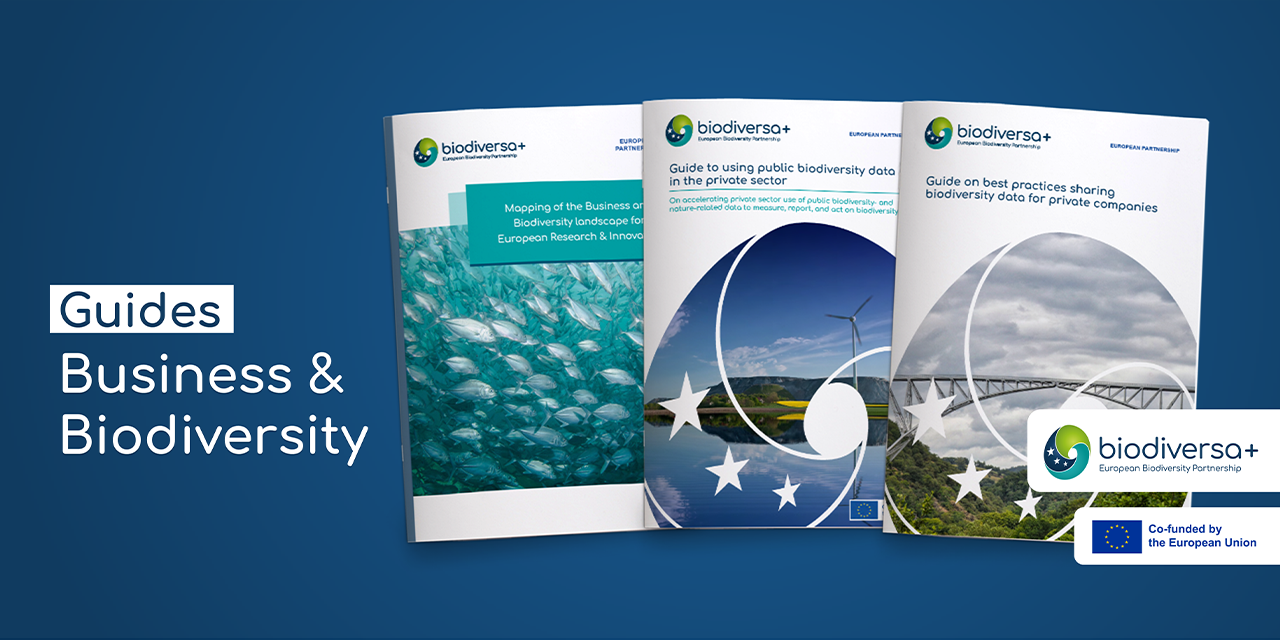
Long documented by science but long underestimated in economic decision-making, biodiversity loss is now recognised as a material economic and financial risk. The World Economic Forum’s newly released 2026 Global Risks Report ranks it among the most severe long‑term global threats, second only to extreme weather events. In this context, Biodiversa+ is publishing three new reports showing how businesses and financial institutions can turn biodiversity data into practical action.
Released during the World Economic Forum Annual Meeting (19-23 January 2026) and ahead of the adoption of the IPBES Business and Biodiversity Assessment (9 February 2026), the reports provide concrete European evidence on how biodiversity data are produced, used, and shared by companies in practice, and why this matters for risk management, accountability, and nature-positive transitions.
Together, the reports respond to a growing gap between expectations and reality: while businesses are increasingly required to disclose and manage nature-related risks, biodiversity data remain fragmented, unevenly used, and largely disconnected from decision-making.
Why biodiversity data has become a business issue
More than half of global GDP depends on nature. Yet biodiversity loss is accelerating, exposing companies and financial institutions to rising operational, regulatory, and reputational risks.
At the same time:
- Companies collect large volumes of biodiversity data through environmental impact assessments, monitoring, and sustainability activities.
- New regulatory and voluntary frameworks – including CSRD, the EU Taxonomy, and TNFD – are increasing expectations on how companies assess and disclose biodiversity impacts and dependencies, reflecting the EU’s double materiality approach.
- Investors and regulators are increasingly asking not only whether companies act for biodiversity, but how they know whether their actions work.
Because business decisions and financial flows strongly influence land use, resource extraction, and supply chains, the private sector has a decisive role in bending the curve of biodiversity loss, and data is central to making that role measurable and accountable.
The Biodiversa+ reports address this challenge by focusing on the role of data as a bridge between biodiversity science, business decisions, and public policy. They frame biodiversity data as part of an information flow: from on-the-ground observations and monitoring, through aggregation, interpretation, and standards, into business decision-making, reporting, and public policy.
From global evidence to practical implementation
The forthcoming IPBES Business and Biodiversity Assessment will provide the first global scientific assessment of how businesses depend on and impact biodiversity, and what transformative change is required.
The three Biodiversa+ reports complement this global evidence by focusing on implementation: how biodiversity data are already used by companies, where barriers persist, and how existing data can be mobilised more effectively. Together, they support organisations navigating both regulatory requirements such as the CSRD and voluntary frameworks such as the TNFD, helping shift from risk identification toward informed decision‑making on impacts, dependencies, and action.
Key insights
- Biodiversity loss is a systemic business risk: Mapping across sectors shows that nearly all business activities affect biodiversity directly or indirectly. Financial flows harmful to biodiversity still vastly outweigh positive investments, highlighting the central role of finance in enabling change.
- Businesses already use biodiversity data, but mainly for scoping and prioritisation rather than for operational decision-making: Case studies show that companies increasingly rely on public biodiversity datasets and screening tools to identify hotspots, prioritise action, and manage risk, often working under uncertainty.
- Private-sector biodiversity data is an untapped resource: Despite extensive data collection by companies, only a very small share of global biodiversity datasets published on platforms such as GBIF currently come from the private sector. This represents a missed opportunity for science and policy.
- Responsible data sharing is feasible and strategically valuable: The reports show that legal, technical, and confidentiality barriers can be managed through emerging standards, intermediaries, and step-by-step approaches. When embedded in governance, data sharing becomes a lever for credibility, regulatory readiness, and operational learning.
Three complementary reports, one integrated perspective
The reports address complementary parts of the same challenge:
- Mapping the business and biodiversity landscape for European Research & Innovation: Provides an overview of actors, policies, tools, and research shaping the business-biodiversity agenda, highlighting fragmentation, gaps, and leverage points.
- Guidance to accelerate the use of public biodiversity data by companies: Examines how companies actually work with biodiversity data in decision-making, risk screening, and reporting, and what this implies for data providers, policymakers, and researchers.
- Guide on best practices for sharing biodiversity data for private companies: Offers practical guidance on how companies can share biodiversity data responsibly, aligned with FAIR principles and existing platforms such as GBIF and OBIS.
Supporting uptake and dialogue
To support application in practice, Biodiversa+ will host a series of webinars in February and March 2026, in collaboration with report partners. A dedicated in-person workshop will follow on 10 June 2026 in Paris in partnership with Banque de France and several other European projects.
About the reports
The reports were produced by Biodiversa+ in collaboration with EY denkstatt Bulgaria, Innovation Fund Denmark, KPMG Netherlands, the Naturalis Biodiversity Center, and the University of Twente. The work combines expertise in biodiversity science, corporate sustainability and regulation, data infrastructures, and policy analysis. It draws on case studies, expert interviews, and input from businesses, financial institutions, researchers, and public authorities across sectors. The reports were reviewed by Biodiversa+ partners to ensure scientific robustness, policy relevance, and consistency with European biodiversity and sustainability objectives.