“Automated Biodiversity Monitoring Stations – ABMS Pilot report“
Published: December 2025 | DOI: 10.5281/zenodo.20826247
Automated biodiversity monitoring can help fill important data gaps by collecting standardised observations across wider areas, longer time periods and multiple taxonomic groups. Sensors and artificial intelligence offer new possibilities for monitoring species that are difficult to observe through traditional methods, including bats, birds and night-flying insects.
This report presents the outcomes of the Biodiversa+ Automated Biodiversity Monitoring Stations (ABMS) Pilot, which tested a transnational sensor network for biodiversity monitoring across Europe. Running throughout 2024 and 2025, the pilot deployed around 200 sensors at 70 sampling locations across 12 EU Member States.
Context
Understanding biodiversity change requires data that are consistent across space, time and taxonomic groups. Traditional monitoring provides high-quality information, but it can be difficult to expand to cover large areas, long periods and taxa that are hard to detect. Automated monitoring offers a complementary approach. Acoustic recorders, insect cameras and environmental loggers can collect repeated observations with limited disturbance and high temporal coverage. When combined with AI-assisted processing, they can generate large datasets on species activity, abundance patterns, phenology and diversity.
Deploying automated methods at transnational scale is more than a technical challenge. It also requires coordination, agreed protocols, data management infrastructure, expert validation and realistic expectations about costs, equipment reliability and AI uncertainty.
The ABMS Pilot implemented a coordinated sensor network to monitor three broad taxonomic groups: birds, bats and night-flying insects. Sampling took place across forest, grassland and wetland sites, selected to represent different ecological contexts across Europe.
The pilot tested:
- acoustic recorders for birds and bats;
- automated camera systems for night-flying insects;
- temperature and moisture loggers;
- centralised data storage and processing;
- AI pipelines for detecting and classifying species from sounds and images;
- expert verification workflows to assess AI outputs;
- indicators derived from sensor data, including phenology, community abundance and taxonomic diversity.
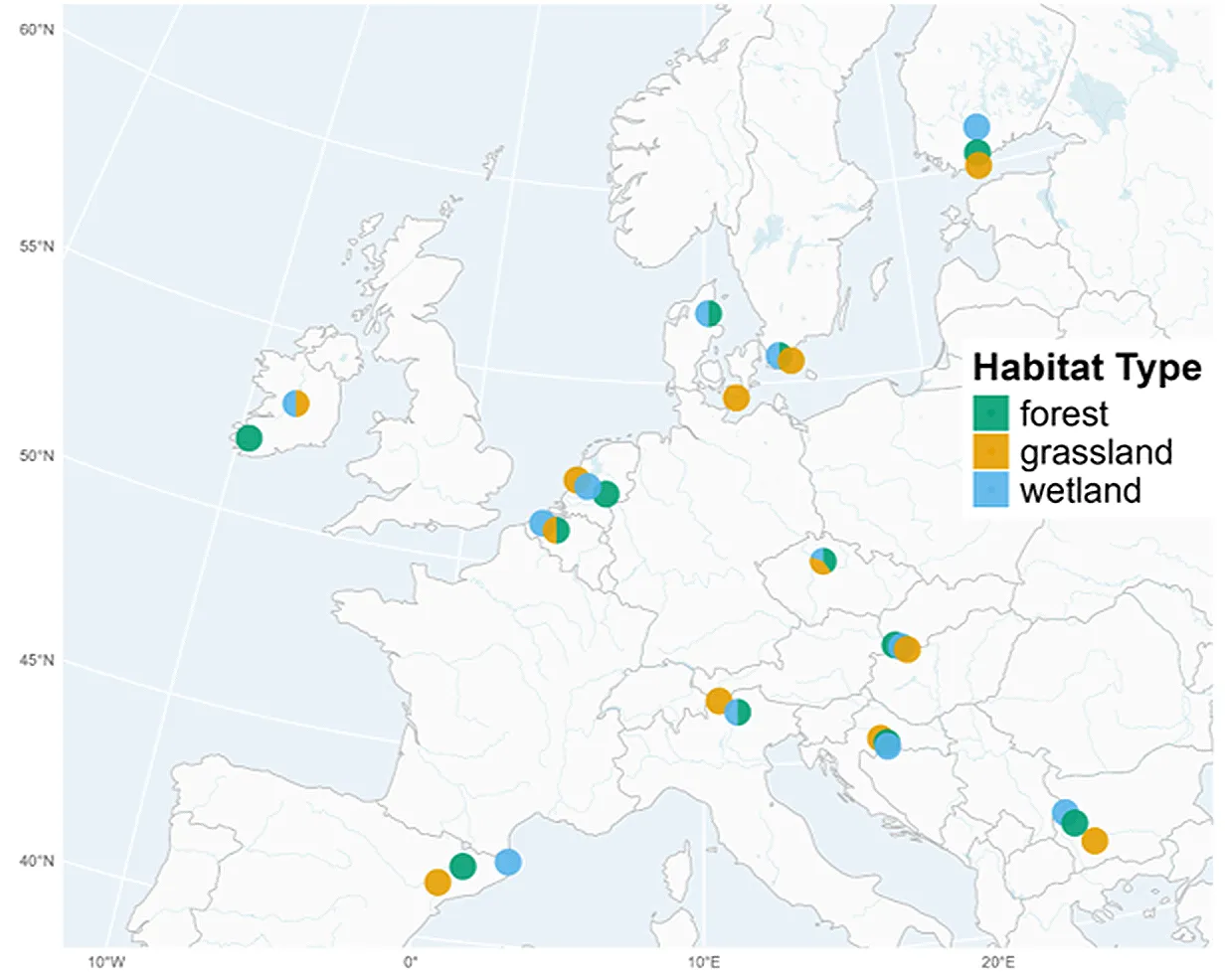
ABMS sampling sites across Europe, covering forest, grassland and wetland habitats.
Main takeaways
- Sensor networks are viable for transnational biodiversity monitoring. The pilot showed that automated monitoring stations can be deployed across countries and habitats to collect standardised biodiversity data. Partners reported that ABMS approaches could be integrated into national monitoring contexts, provided the right support and coordination are in place.
- Automated monitoring can generate large and diverse datasets. The pilot produced millions of audio files, images and environmental records. These data provide opportunities to explore biodiversity patterns across habitats, countries and seasons, including for taxa that are difficult to observe consistently through conventional methods.
- AI processing is essential, but not sufficient on its own. Open-source AI pipelines were used to process bird, bat and insect data. These tools generated large numbers of preliminary species records, but the pilot underlines the importance of expert verification to assess uncertainty, calibrate confidence and ensure that outputs can be interpreted responsibly.
- Data management is central to scaling up. The volume and complexity of sensor data make robust data infrastructure essential. The pilot tested centralised processing and storage, while also highlighting the value of local processing options to support partner engagement, understanding and capacity building.
- Sensor-based data can support biodiversity indicators. The pilot also demonstrates how automated data can contribute to indicators linked to Essential Biodiversity Variables. Examples include ecosystem phenology indicators, community abundance indices and taxonomic diversity indicators.
- Coordination is fundamental. The pilot shows that sensor networks require more than devices in the field. Shared protocols, maintenance planning, expert support, central processing, metadata standards and long-term coordination are needed to make automated monitoring reliable and useful.
Towards a European biodiversity sensor network
The ABMS Pilot provides a proof of concept for developing a European sensor‑based biodiversity monitoring network, while highlighting key practical constraints. Equipment costs and availability may exceed expectations; sensors influence site selection and sampling design; data gaps are inevitable; and AI outputs require careful validation.
The report offers practical insights and points towards a realistic, coordinated approach that combines automated sensors, AI pipelines, expert validation, local engagement, and centralised infrastructure. Together, these elements support scalable monitoring while ensuring that the resulting data can underpin robust biodiversity indicators and policy‑relevant evidence.