“Monitoring European Rocky Reef Fishes – EuRockFish Pilot report“
Published: December 2025 | DOI: 10.5281/zenodo.20829142
Rocky reef fish communities play important ecological roles in European coastal ecosystems. They are also relevant for food, tourism, local economies and the functioning of marine habitats. Yet, across Europe and adjacent seas, reef fish monitoring remains uneven, with methods, indicators and data collection practices varying between countries and monitoring schemes.
This report presents the outcomes of the Biodiversa+ EuRockFish Pilot, launched to support the development of a more harmonised approach to monitoring European rocky reef fish. Running throughout 2024 and 2025, the pilot focused on reef fish assemblages associated with infralittoral and circalittoral hard-bottom habitats, including rocky reefs, boulder reefs and complex artificial structures such as offshore wind farms.
Context
Understanding how marine ecosystems respond to pressures such as climate change, pollution, and invasive species requires long-term monitoring capable of detecting changes in species composition, abundance, distribution, and ecological functioning. Despite their importance as components of coastal ecosystems, rocky reef fish remain subject to fragmented monitoring. Some countries rely on underwater visual surveys, others use video-based approaches or molecular tools such as environmental DNA. These methods are valuable, but differences in protocols and sampling designs make it difficult to compare results across regions.
The EuRockFish Pilot addressed this gap by testing how complementary methods can be combined within a shared methodological framework. Its broader objective was to support a European rocky reef fish monitoring network capable of producing interoperable data for ecosystem assessment and policy implementation.
The pilot focused on three complementary monitoring methods:
- Underwater Visual Census, based on scuba diving surveys;
- Baited Remote Underwater Video, using underwater video stations to observe fish assemblages;
- environmental DNA (eDNA) metabarcoding, using water samples to detect species through genetic traces.
The pilot also considered how these methods can be combined to assess reef fish assemblages, detect non-indigenous species, and support the development of fish-related indicators for marine policy frameworks.
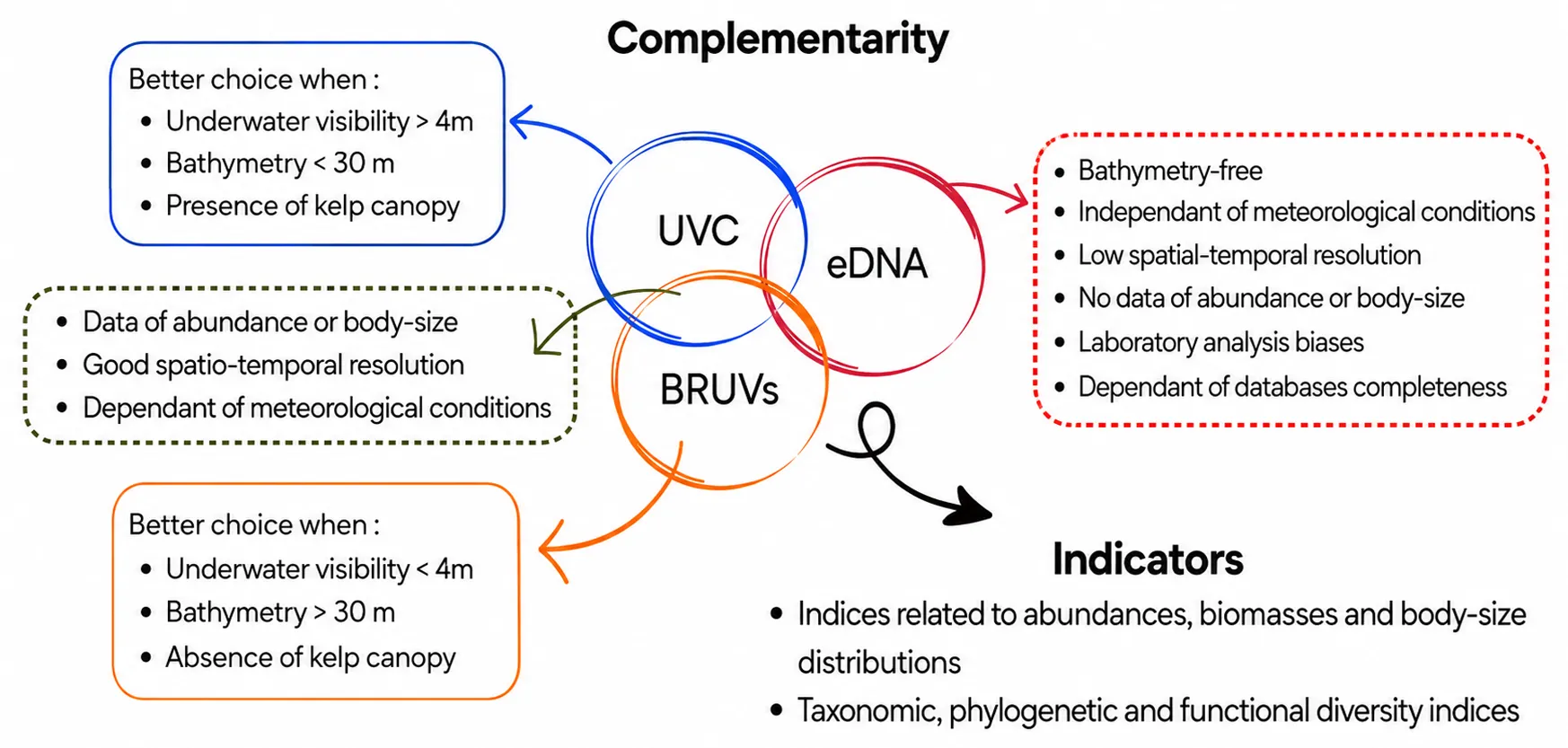
Complementarity between the three monitoring methods tested in the EuRockFish Pilot: underwater visual census, baited remote underwater video and environmental DNA.
Main takeaways
- Reef fish monitoring needs stronger European coordination. Current monitoring efforts remain fragmented across countries and monitoring schemes. A common framework can help improve comparability, support long-term time series and strengthen the scientific basis for marine ecosystem assessments.
- No single method captures everything. Underwater visual census, baited remote underwater video and eDNA each provide different types of information. Combining these methods can improve understanding of reef fish assemblages and help address the limitations of individual approaches.
- Harmonisation does not always mean replacing existing protocols. In some regions, established monitoring time series already exist and changing these protocols can be difficult. Inter-calibration can support harmonisation while preserving valuable long-term datasets.
- Monitoring should be designed for policy use. Reef fish monitoring can better support the Marine Strategy Framework Directive, Regional Sea Conventions and Marine Protected Area management when methods generate comparable and interpretable data. This is also important for tracking changes in reef fish distribution and the spread of non-indigenous species.
- Data management and accessibility are central. The pilot points to the importance of centralising data, applying FAIR principles and using existing biodiversity data infrastructures such as GBIF and OBIS to make results accessible for future research and policy use.
- Practical implementation requires flexibility. The pilot encountered regulatory, administrative and logistical constraints, including differences in professional diving rules, site access and environmental DNA sample handling. These experiences provide useful lessons for future transnational monitoring efforts.
Towards a European rocky reef fish monitoring network
EuRockFish serves as a proof of concept for a more coordinated approach to rocky reef fish monitoring across European and adjacent seas. By developing and testing shared protocols, the pilot lays the groundwork for producing comparable data while respecting regional contexts and existing practices.
The report also outlines next steps, including analysing the full pilot dataset, refining the methodological framework, preparing guidance for long-term reef fish monitoring, and supporting data publication in line with FAIR principles. Together, these elements provide practical insights to advance the harmonisation of monitoring efforts and better support European marine policy and conservation objectives.