
Picture: Rete Italiana Ripristino Ecologico APS – RIRE
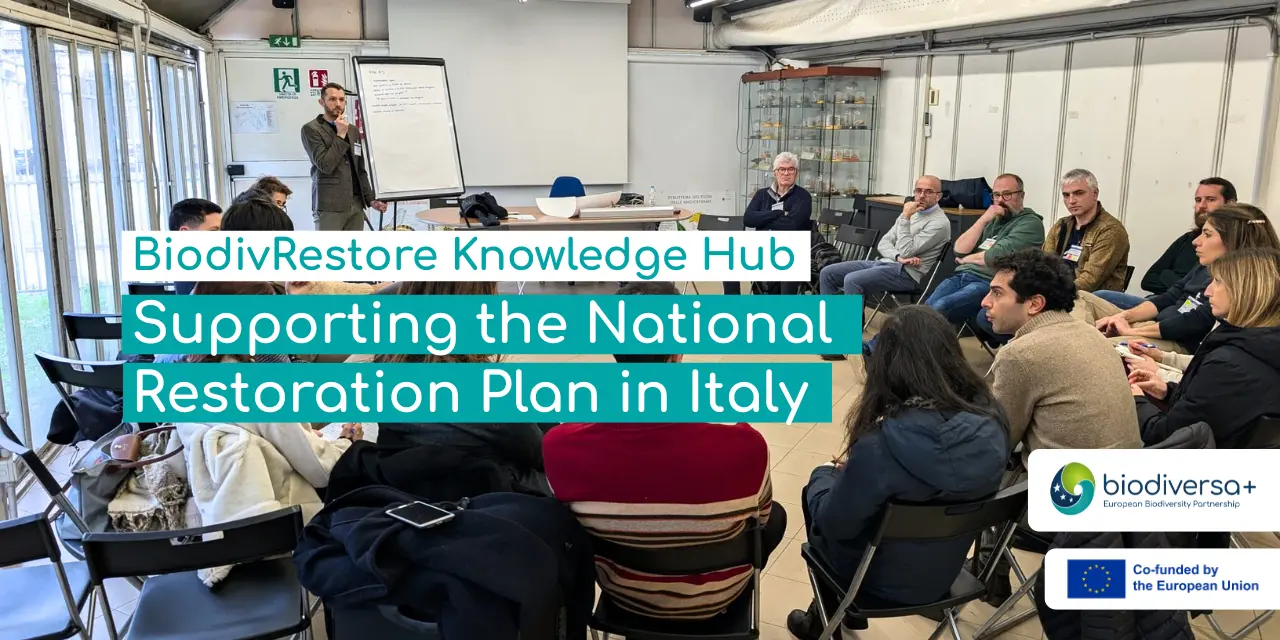
The BiodivRestore Knowledge Hub continues to spread its work across Europe. On 30 January 2026, Vito Emanuele Cambria, a member of the Knowledge Hub, presented the Hub’s activities and brought input to support the National Restoration Plans (NRP) drafting process during the conference “The Nature Restoration Law: Technical Pathways for Developing the National Restoration Plan”, at the Botanical Garden of Rome. One of the missions of the Hub is to empower countries to develop and implement national restoration plans, ultimately achieving the targets set by the EU and UN initiatives.
The conference was organised by the newly established Italian Network for Ecological Restoration (Rete Italiana Ripristino Ecologico APS – RIRE), in collaboration with the project PRIN 2022 PNRR “Restoring Biodiversity as a Tool for Climate Change Mitigation”. It brought together researchers, technicians, professionals, and institutional representatives, with more than 90 participants in person and around 130 participants online. Together, they discussed challenges and opportunities related to Italy’s National Restoration Plan and its consultation process. The morning was dedicated to plenary sessions, and the afternoon to workshops.
Several themes directly echoed the ongoing Knowledge Hub reflections
- Data and monitoring frameworks: how Member States are structuring baseline data collection, impact assessments, and monitoring systems.
- Governance and science–policy interface: the importance of structured consultation processes and early engagement of the scientific community. In Italy, the NRP is being developed through an adaptive, stepwise approach that builds on existing measures while identifying knowledge gaps for future strengthening. This topic is highly relevant for KH exchanges on feasibility and implementation pathways.
- Quality standards and evaluation of restoration projects: how practitioners and policymarkers are defining criteria and indicators to assess restoration quality (e.g. alignment with existing international frameworks, long-term monitoring plans, multi-taxa indicators, ecosystem functionality metrics, and socio-economic dimensions).
- Supply chains and technical bottlenecks: the need for a stable supply chain of native plant material and high-quality germplasm, directly linked to implementation feasibility, scalability, and coherence with climate adaptation scenarios.
- Innovation and research frontiers: beyond structural habitat reconstruction, the need for restoration of ecological processes (soil functionality, hydromorphological processes, connectivity at the bioregional scale), integration of remote sensing and advanced monitoring tools, and the need for hybrid professional skills combining ecology, governance, and applied practice.