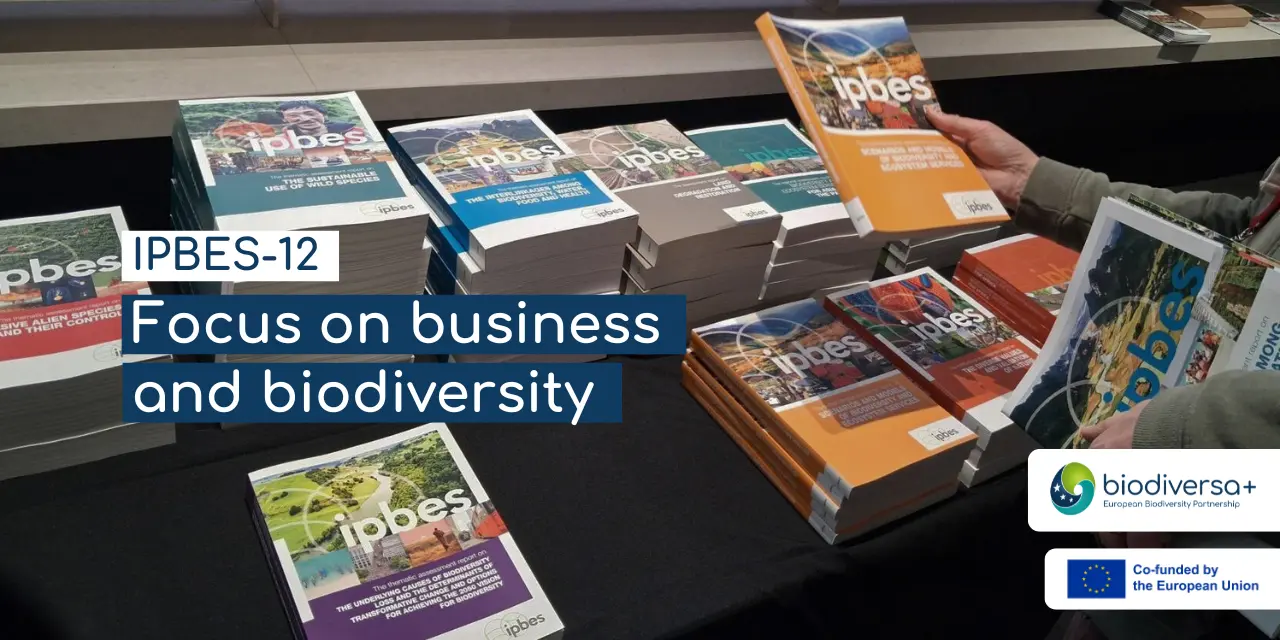
The relationship between economic activity and biodiversity is central in the global agenda. The Intergovernmental Science-Policy Platform on Biodiversity and Ecosystem Services (IPBES) is dedicating major attention to a critical issue: the impact and dependence of business on biodiversity.
This topic takes center stage at IPBES-12 Plenary and Stakeholder day, held in Manchester from 2 to 8 February 2026. The member States’ representatives will work toward the approval of the Business and Biodiversity Assessment and the Summary for Policymakers, which examine how businesses both rely on nature and contribute to biodiversity loss, and how it can be better understood and measured.
While IPBES sets the global evidence base, Biodiversa+ recently released a series of three guides on Business and Biodiversity, focusing on how biodiversity data are already being used and shared in practice in Europe, and how this can be strengthened to support real-world action.
Biodiversa+ activities at IPBES-12
Biodiversa+ is actively engaged in the IPBES-12 process, including co-organising, with RESPIN, a session during the Stakeholder Day (2 February), addressing two key topics:
- a panel discussion on how stakeholders can take up IPBES findings, showcasing examples of uptake at different scales;
- an interactive session on behaviour change communication and on how to better engage participants in workshops, to enhance the uptake of IPBES assessments.
Biodiversa+ is also representing the ECA Network as one of its main coordinators during the Marketplace (Stakeholders Networks stall), showcasing the work on capacity building, with the goal of empowering European stakeholders to participate in IPBES processes.
Since 2012, Biodiversa+ has been contributing to the four main functions of IPBES
- Assessing knowledge: developing factsheets based on peer-reviewed publications from Biodiversa‑funded projects, feeding into IPBES assessments.
- Building capacity: generating actionable knowledge to tackle the direct and indirect drivers of biodiversity loss and ecosystem degradation.
- Strengthening the knowledge foundations: supporting the identification, monitoring, and uptake of IPBES knowledge gaps by improving their monitoring and uptake, and by working with researchers to integrate them into their research questions.
- Supporting policy: organising webinars to support the engagement of European experts in IPBES processes, helping them to become authors or reviewers, and contributes to the organisation and programming of the Pan-European Stakeholder Consultation (PESC) meetings.