

Duration
2026-2028
Partners involved
The pilot is coordinated by the Nature Conservation Agency of the Czech Republic (NCA_CR).
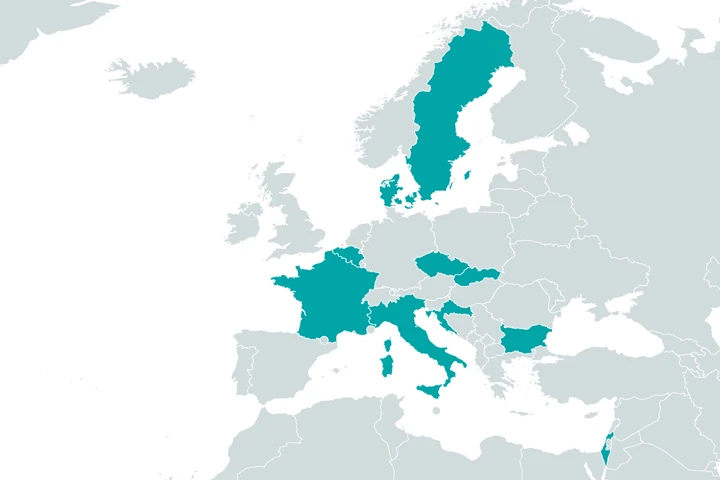
It involves partners from ten countries: Belgium (Flanders), Bulgaria, Croatia, Czech Republic, Denmark, France, Israel, Italy (Autonomous Province of Bolzano), Slovakia and Sweden.
External collaboration
The pilot builds on and collaborates with initiatives including PONDERFUL, EuropaBON, CIMaE, GBIF, ClimBats and the Biodiversa+ ABMS pilot. These collaborations support protocol alignment, data sharing, indicator development, and synergies in acoustic and genomic monitoring.
More information
Context
Ponds are among the most widespread freshwater ecosystems in Europe and support a disproportionately high share of biodiversity, yet they remain largely neglected in European monitoring frameworks. Their scattered distribution makes traditional large-scale monitoring difficult and costly.
BiodivPond addresses this gap by testing a harmonised European approach that combines environmental DNA, passive acoustic monitoring and citizen science to generate improved biodiversity data for pond ecosystems and their surrounding wetlands, while assessing the effectiveness and applicability of both traditional and novel monitoring methods.
Main objectives
This pilot focuses on:
- establishing a transnational pond monitoring network across Europe;
- developing a citizen-science-based monitoring scheme for ponds;
- creating shared open-access infrastructures for genomic and acoustic data;
- testing workflows to integrate eDNA and acoustic data into wider biodiversity databases and European monitoring frameworks;
- developing user-friendly visualisation tools for biodiversity data.
Main activities
The pilot is structured around three main modules. The first focuses on aquatic biodiversity in 6 core ponds per country, using eDNA and traditional field methods to monitor amphibians, fish and aquatic macroinvertebrates. The second uses passive acoustic monitoring to assess bat activity and, where relevant, calling amphibians at the same sites. The third expands monitoring to around 500 additional ponds through citizen science, supported by training, outreach materials and national workshops. Together, these activities will help test how new methods can support robust and comparable pond monitoring across Europe.
Main outcomes
The pilot will produce a report evaluating eDNA, passive acoustic monitoring and traditional methods, alongside practical citizen-science guidelines and dedicated outputs on Triturus cristatus monitoring. It will also deliver harmonised datasets from both core ponds and citizen-science sites, helping to lay the groundwork for long-term, restoration-relevant monitoring of pond ecosystems in Europe.