“Updated Biodiversa Stakeholder Engagement Handbook” [draft version]
Published: October 2026
Engaging people and organisations that influence, use or are affected by research can improve its relevance, quality and societal impact. Building on the first edition published in 2014, Biodiversa+’s updated Stakeholder Engagement Handbook offers expanded guidance to help research teams involve stakeholders throughout their projects, with flexible approaches that can be adapted to project objectives, available resources, and participant needs. The handbook pays particular attention to whose perspectives are represented, how decisions are made and how the benefits, demands and risks of participation are shared.
Explore the guidance
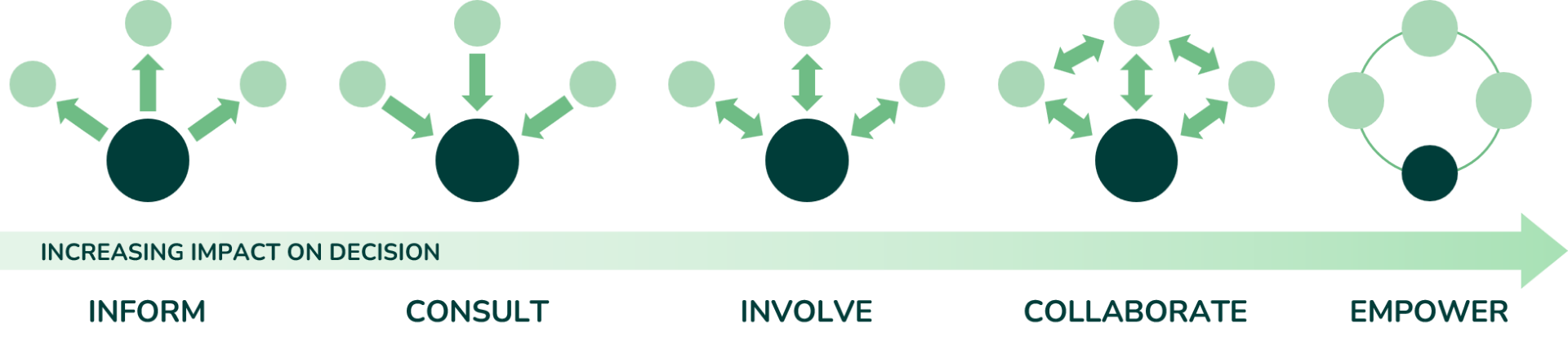
Stakeholders can participate in research in different ways, with different opportunities to influence decisions. The engagement spectrum provides a starting point for understanding these approaches.
Stakeholder selection begins with understanding who is connected to the research, who may be affected by its outcomes and whose knowledge or involvement could be relevant. The handbook recommends a three-step approach:
- Identify potential stakeholders: develop a broad picture of relevant individuals, groups, communities and organisations. consult project partners and stakeholders themselves to identify perspectives that might otherwise be overlooked.
- Assess stakeholder relevance: consider their interests, rights, responsibilities, knowledge and relationship to the research, alongside their influence over decisions and implementation.
- Understand stakeholders. Explore their priorities, expectations, existing relationships and capacity to participate.
Revisit this process throughout the project lifecycle, as relationships, priorities and opportunities may evolve. Particular attention should be given to stakeholders who may be significantly affected by the research but have limited influence over decisions. It is also important to recognise that broad categories such as “farmers”, “businesses”, or “local communities” often encompass diverse interests, needs, and experiences.
Further guidance: Part IV – Selecting relevant stakeholders.
NARROW brought ecological research into dialogue with local and Indigenous knowledge in Sweden and Finland. The project found that communities could understand environmental problems and restoration priorities differently from authorities and researchers. The team explored these perspectives through interviews, workshops and field visits, highlighting why understanding stakeholders’ knowledge, values and relationships with a landscape matters when designing research and restoration approaches.
Drawing on the IAP2 Spectrum of Public Participation, the handbook distinguishes five levels of engagement:
- Inform: provide balanced, accessible information to help stakeholders understand the research, its progress and its results.
- Consult: seek stakeholders’ views and feedback to inform decisions, while retaining responsibility for those decisions within the research team.
- Involve: enable stakeholders to contribute knowledge, expertise, data or resources, and explain how their contributions have informed the research.
- Collaborate: work together to shape research questions, activities or outputs, with stakeholders participating in decision-making.
- Empower: support stakeholders’ capacity to influence decisions and lead action, with researchers providing knowledge and support. This may extend to stakeholder-led governance.
A project may combine several levels for different stakeholder groups and stages of the research. The appropriate approach depends on the objectives, context and participants. Be clear about what participants can influence and how decisions will be made. This helps establish realistic expectations and enables people to decide how they wish to participate.
Further guidance: Part II – Why engage with stakeholders and Part V – Methods of engagement.
Farms4Biodiversity involved farmers in Malawi through ecological data collection, experiments, surveys, participatory mapping and discussions about land-use and biodiversity management. Farmers also trained others in data collection and agro-ecological practices. These activities contributed local knowledge and ecological data, while increased community interest in forests prompted follow-up research. The example illustrates how stakeholders can contribute in several ways as research develops.
Choose methods according to the purpose of the activity, the participants, the stage of the research and the intended level of influence. Examples explored in the handbook include:
- Interviews and surveys to gather stakeholders’ perspectives, knowledge, needs and feedback.
- World Café to explore perspectives and identifying shared themes through small-group discussions over several rounds.
- Participatory mapping to bring stakeholders’ experiences and knowledge into a shared exploration of places and issues.
- Multi-criteria evaluation to compare options against environmental, social, economic or other criteria to support transparent decisions
The way a method is used matters. A workshop might collect feedback on an existing proposal or enable participants to develop research priorities together. Its format alone does not determine how much influence participants have. Discussing intended outcomes with participants early can help identify suitable approaches.
Further guidance: Part V – Methods of engagement.
SoilRise involved students, farmers, gardeners and local land managers in collecting data on earthworms and soil biodiversity. Participants engaged differently than expected, with many volunteers preferring data collection at their own sites to mentoring others. Approaches were adapted across countries, including through university courses and existing volunteer networks. The experience illustrates the value of tailoring methods to participants’ preferences and local contexts.
Plan engagement while there is still scope for participants to influence the research. Before organising activities, clarify:
- Purpose: what should engagement contribute to the research and to the people involved?
- Influence: which questions and decisions can participants shape, and which constraints are already fixed?
- Participation: whose perspectives are needed, what barriers might they face and what support would help them participate?
- Resources: what time, budget and facilitation skills are available?
- Follow-up: how will contributions be recognised, how will participants learn what happened to their input and how will relationships be maintained or brought to a respectful close?
Ethical responsibilities run throughout the process. Participation should be voluntary and informed, with clear arrangements for handling, attributing and sharing contributions.
Further guidance: PART III – Ethical principles for engagement
ConservES brought farmers and researchers together to explore how flowering strips could support biodiversity and ecosystem services. However, the project needed to establish experiments early enough to collect sufficient ecological data. Important design choices were therefore made before farmers were fully involved, limiting the scope to incorporate their input into the experimental design. The experience highlights the importance of early engagement and sufficient flexibility when planning co-design.
Understand and manage disagreement
Differences in interests, values, rights, knowledge and expectations can lead to conflict. Before choosing a response, understand the issues, their history, the people involved and the power relations between them. Consider which outcomes might be acceptable to different participants and whether independent facilitation or mediation is needed. Fair, transparent processes can help people continue working together even where disagreements persist.
Evaluate and adapt
Build evaluation into engagement from the outset. Consider:
- The process: were activities accessible, inclusive and appropriate? Could participants contribute meaningfully?
- The outcomes: how did stakeholder input influence research activities, decisions or outputs? Did relationships, knowledge exchange or capacity improve?
- Longer-term effects: did benefits continue beyond the project? Were there unintended consequences?
Use feedback during the project to adjust activities and explain to participants how their contributions have been used.
Further guidance: Part VI – Managing stakeholder conflict, and Part VII – Monitoring and evaluating engagement.
WOBEC integrated evaluation into its stakeholder engagement and knowledge co-production process. Reflection led the team to replace a planned future-visioning exercise with a workshop session reviewing its Antarctic biodiversity observatory blueprint and sharing expedition findings. Participants contributed suggestions for improving the blueprint, showing how adapting engagement to participants’ expertise and evolving research needs can generate useful input.
Handbook contents
The handbook combines practical guidance with case studies from Biodiversa-funded projects. Its seven parts can be read together or consulted independently:
- Introduction: understand stakeholder engagement, its role in research and its connection to societal impact.
- Why engage with stakeholders: explore the benefits, levels and challenges of engagement.
- Ethical principles: address inclusion, power relations, informed consent, and responsible handling of data and knowledge.
- Selecting stakeholders: identify potential stakeholders, assess their relevance and understand their perspectives.
- Methods of engagement: select methods and plan activities, including their timing, resources and facilitation.
- Managing conflict: understand different perspectives, assess conflicts and identify ways to manage them.
- Monitoring and evaluating: assess engagement processes and outcomes, and use feedback to adapt activities.
- An annex provides guidelines for research with Indigenous Peoples.