“Remote sensing for habitat monitoring – Habitat Pilot report“
Published: December 2025 | DOI: 10.5281/zenodo.20824386
Grassland and wetland habitats are among Europe’s most valuable and threatened ecosystems. Monitoring their extent and condition is essential for conservation, restoration planning and policy reporting, including in the context of the EU Nature Restoration Regulation and the EU Biodiversity Strategy for 2030.
This report presents the outcomes of the Biodiversa+ Habitat Pilot, which explored how remote sensing can strengthen and complement existing habitat monitoring frameworks. Implemented between 2023 and 2025, the pilot tested a set of remote-sensing-based approaches for mapping and monitoring grassland and wetland habitats across several European regions.
Context
Monitoring grassland and wetland habitats across Europe currently relies largely on national field-based methods, which differ in scope, frequency and indicators. Field surveys provide high-quality ecological information, but are often limited in spatial coverage. Remote sensing offers new opportunities to monitor habitats across larger areas and over time. Satellite, airborne and drone-based approaches can help assess ecological attributes such as vegetation structure, hydrological dynamics, seasonal productivity and habitat extent.
However, remote sensing is not a simple replacement for field monitoring. Its usefulness depends on how well methods are validated, how outputs are interpreted, and whether indicators can be linked to meaningful ecological and policy questions.
The Habitat Pilot was organised around seven thematic subtasks, each addressing a different component of a potential transnational habitat monitoring system:
- European Grassland Watch validation;
- mapping of open grassland habitats;
- measuring vegetation height and cover with remote sensing;
- super-resolution enhancement of satellite imagery;
- habitat segmentation and classification using the NaturaSat approach;
- inundation mapping;
- indicators for habitat condition monitoring.
Together, these subtasks assessed the feasibility, strengths and limitations of using Earth-observation-based approaches to map and monitor the extent and ecological condition of grasslands and wetlands.
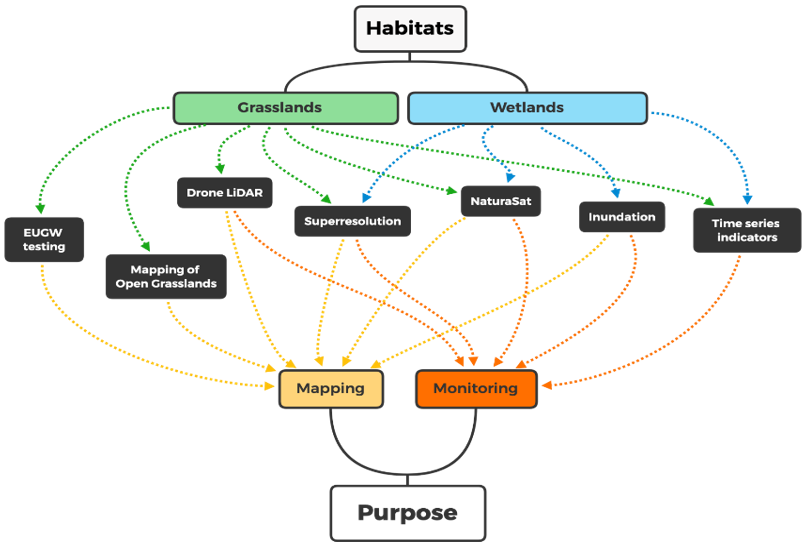
Overview of the Habitat Pilot subtasks and how they relate to grassland and wetland habitat mapping and monitoring.
Main takeaways
- Remote sensing can strengthen habitat monitoring. The pilot demonstrated that remote-sensing-based approaches can support the assessment of key ecological attributes, including inundation dynamics, vegetation structure, seasonal productivity and the distribution of potentially valuable grasslands.
- Field data remain essential. Across several subtasks, in situ data were crucial for validating outputs and interpreting remote-sensing indicators. The pilot shows that remote sensing and field-based monitoring should be seen as complementary parts of an integrated system.
- Some methods are ready for further development and scaling. Several approaches showed strong potential, including simple optical inundation models, time-series indicators for hydrological and seasonal dynamics, semi-automatic workflows for identifying potential open grasslands, and drone-based LiDAR combined with deep learning for fine-resolution vegetation structure mapping.
- Other approaches still need refinement. The pilot also identified methods that remain promising but require further development before operational use, including habitat segmentation and the mapping of fine-scale habitat features using super-resolution.
- Harmonisation is possible, but flexibility is needed. Differences in national datasets, habitat definitions, reference data and ecological contexts influenced method performance. The pilot therefore points towards a modular monitoring framework that supports comparability across Europe while allowing regional flexibility where needed.
- Large-scale deployment needs shared standards and infrastructure. The pilot highlights the need for shared processing standards, consistent validation protocols, improved training data and cloud-based infrastructures to support the wider use of remote sensing in habitat monitoring.
Towards harmonised transnational habitat monitoring
The Habitat Pilot provides a proof of concept for using a coordinated portfolio of remote-sensing-based approaches in European habitat monitoring. It also identifies practical requirements for future implementation, including clearer governance, shared protocols, data and sample management, quality control, and stronger links between remote-sensing products and ecological indicators.
For anyone working on biodiversity monitoring, habitat mapping, restoration planning and environmental reporting, this report provides a practical basis for strengthening the role of remote sensing in habitat monitoring, while maintaining the ecological expertise, validation and coordination needed for reliable policy use.