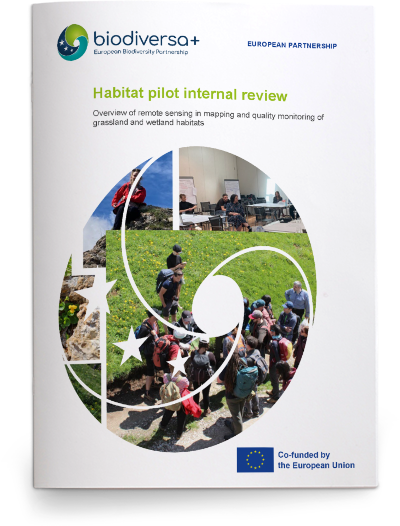
“Habitat Pilot internal review – Overview of remote sensing in mapping and quality monitoring of grassland and wetland habitats”
Published: October 2024 | DOI: 10.5281/zenodo.20815525
Grassland and wetland habitats are among Europe’s most valuable and threatened ecosystems. Monitoring their extent and condition is essential for conservation, restoration planning and policy reporting, including in the context of the EU Nature Restoration Regulation and the EU Biodiversity Strategy for 2030.
This report presents the outcomes of the first module of the Biodiversa+ Habitat Pilot, which reviewed existing methods for mapping and quality monitoring of grassland and wetland habitats across Europe. Conducted from January to August 2024, this first module focused on remote sensing technologies and other methodologies currently used by pilot partners and related habitat mapping initiatives.
Context
Across Europe, policy frameworks increasingly require robust information on habitat extent, condition and change. Yet methods for mapping and assessing habitat and ecosystem condition are not always harmonised, which can make reporting, comparison and evaluation more difficult across countries and regions.
Remote sensing can help address some of these challenges. Satellite, airborne, LiDAR and drone-based approaches can complement field surveys, support broader spatial coverage and enable more regular monitoring. However, their use is not straightforward. Accuracy, reliability, data availability, technical capacity and validation remain important constraints.
The Biodiversa+ Habitat Pilot responds to this need by exploring how remote sensing and other methods can contribute to more harmonised habitat mapping and quality monitoring, with a particular focus on grassland and wetland habitats.
Main takeaways
- Current methods differ widely across countries and regions. The review shows that partner countries and regions use a wide range of approaches, from traditional field-based mapping to advanced remote sensing and machine-learning methods. This diversity reflects different monitoring histories, data availability, technical capacities and policy needs.
- Field data remain essential. Many partners still rely heavily on in situ field surveys because of their accuracy and reliability. Remote sensing can improve coverage and efficiency, but it does not replace field-based expertise. Ground-truthing and validation remain essential to ensure that remote sensing outputs are suitable for habitat assessment and monitoring.
- Remote sensing offers strong potential, but its use is uneven. Some countries and regions have already integrated remote sensing, LiDAR, UAVs, GIS and machine learning into habitat mapping and monitoring. Others are still testing these approaches or face constraints linked to accuracy, data access, expertise or costs. The report highlights the need to build confidence in remote sensing methods through further testing and validation.
- Harmonisation is needed for comparability. The report underlines the importance of harmonising methodologies across regions to support comparable habitat assessments and reporting. This includes shared approaches to data integration, classification, validation, monitoring updates and interpretation of habitat quality indicators.
- Capacity building is a key condition for scaling up. The review identifies capacity building as essential for the wider use of remote sensing and GIS-based methods. Training, shared workflows, technical support and exchange between countries will be important to improve data quality and support harmonised monitoring across Europe.
Future steps
This review sets the basis for the next phases of the Habitat Pilot. In Modules 2 and 3, partners will test selected mapping and monitoring methods in grassland and wetland pilot sites across participating countries and regions. The results of these tests will feed into Module 4, where outcomes will be gathered and used to develop recommendations for more standardised and efficient habitat mapping and monitoring across Europe.