Urbanisation of the sea – assessing and managing the impact of Offshore Wind developments on open ocean biodiversity
Call
Duration
01/01/2026 – 31/12/2028
Total grant
Approx. 1.6 mil. €
More information
Partners of the project
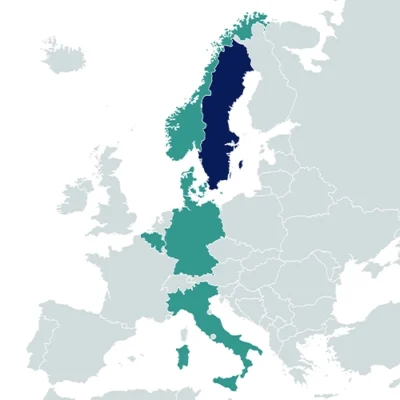
- Department of Wildlife, Fish and Environmental Studies, Swedish University of Agricultural Sciences, Umeå, Sweden
- Climate and Environment, Norwegian Research Centre NORCE, Bergen, Norway
- National Institute for Aquatic Resource, Technical University of Denmark, Silkeborg, Denmark
- Research Department, Flanders Marine Institute, Ostend, Belgium
- Scientific research and development, GEOMAR Helmholtz Centre for Ocean Research Kiel, Kiel, Germany
- Institute of Biosciences and Bioresources, National Research Council, Sesto Fiorentino, Italy
- Department of Animal Sciences and Aquatic Ecology, Ghent University, Gent, Belgium
- Stockholm Resilience Centre, Stockholm University, Stockholm, Sweden
- Institute of Marine Research Flødevigen, Institute of Marine Research, Arendal, Norway
Context
Europe’s rapid offshore wind expansion is central to the renewable energy transition, but it also constitutes an unprecedented, large-scale transformation of open-ocean habitats. The biodiversity consequences of this ‘industrialisation at sea’ remain poorly understood, especially cumulative and long-term effects that emerge across whole seascapes, which are not captured by today’s largely site-based environmental assessments. UrbanOcean addresses this knowledge gap by reframing offshore wind farms as ‘ocean urbanisation’: a build-out of dense infrastructure networks that can fragment habitats, modify sensory environments (noise, light and electromagnetic fields), and disrupt ecological connectivity, particularly for migratory and pelagic fish adapted to the featureless open ocean. This urbanisation also reshapes access to, and governance of, the sea by changing ownership patterns and constraining traditional resource use, with potential winners and losers among stakeholders, and impacts that can propagate across borders and into coastal communities.
Main objectives
UrbanOcean’s overarching aim is to deliver seascape-scale, policy-relevant evidence and tools to reconcile offshore wind deployment with the protection of open-ocean biodiversity and the resilience of fisheries and coastal communities. The project has three main objectives:
- evaluate how stressors interact and scale from local to seascape levels across offshore wind development phases;
- quantify how offshore wind affects fish migration and migratory corridors in the North Sea and Baltic Sea, including potential route changes, delays, attraction/avoidance and displacement;
- develop integrated socio-ecological modelling frameworks to assess cumulative impacts and trade-offs (biodiversity, fisheries, energy yield) that support sustainable, participatory marine spatial planning in the western Baltic Sea region.
Main activities
UrbanOcean will assess the impact of offshore wind on fish at two complementary scales. At the seascape scale, we will synthesise evidence across infrastructure development phases and use large-scale fish telemetry to map migration corridors and connectivity in relation to existing, planned and emerging windfarm clusters. At the local site-scale, we will deploy targeted telemetry around windfarms to quantify behavioural and movement responses, such as attraction/avoidance, changes in routes and delays, thereby linking fine-scale mechanisms to broader cumulative effects. The project will also assess cumulative impacts and trade-offs using ecosystem and simulation models to test different offshore wind and climate scenarios, and turn the results into practical guidance for marine spatial planning. Throughout, the project will work with stakeholders through mapping and recurring workshops and webinars, and deliver policy-ready outputs. UrbanOcean expects to provide seascape-scale evidence and tools that support faster, more transparent and biodiversity-friendly offshore wind planning and governance.