
Leveraging transformative capacities for the governance of human-bear-coexistence in Europe. An integrated socialecological-institutional approach
Call
Duration
15/03/2026 – 15/03/2029
Total grant
Approx. 1.1 mil. €
More information
Partners of the project
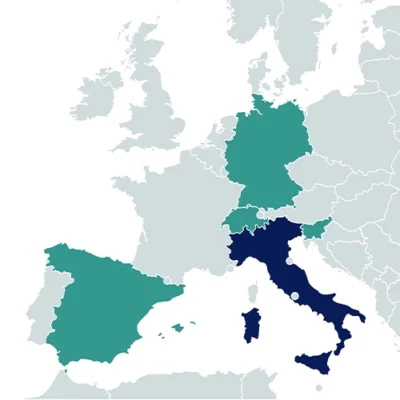
- University G. D’Annunzio of Chieti – Pescara, Italy
- University of Rome La Sapienza, Rome, Italy
- Federal Institute of Technology Zurich, Zurich, Switzerland
- University of Ljubljana, Ljubljana, Slovenia
- Albert-Ludwigs-University Freiburg, Freiburg, Germany
- Institute for Advanced Social Studies, Córdoba, Spain
- Spanish National Research Council, Madrid, Spain
- University of León, León, Spain
Context
Addressing the challenge of biodiversity loss requires Social-Ecological Systems (SES) to develop new pathways that reconfigure human-environment relationships. In this context, reconfiguring human-large carnivore coexistence represents a pressing concern for global biodiversity conservation. CoexHuB focuses on brown bears (Ursus arctos), a symbolic and iconic species presenting unique challenges for coexistence management in human-modified European landscapes.
By working with local partners to understand the ecological, social, and institutional factors that enable or hinder coexistence and to co-develop innovative solutions for coexistence, the project aims to ensure long-term conditions for human-bear coexistence. The project establishes ‘hubs’ of human-bear coexistence (CoexHuB) through interdisciplinary and transdisciplinary collaboration networks across three regions and a gradient of coexistence contexts: the Central Apennines, where bears are highly inbred, stationary and critically endangered; the Cantabrian mountains, where bears are endangered but slowly increasing; and Slovenia, where a high-density bear population is actively managed and of least conservation concern.
By adopting a social-ecological-institutional approach to policy design, CoexHuB aims to identify which coexistence actions and institutions are most likely to succeed under different context-specific conditions. This novel approach will provide an in-depth understanding of common barriers and opportunities for coexistence.
Main objectives
The overarching aim of CoexHuB is to build a set of recommendations that guide policymakers in integrating objectives for bear protection and social legitimacy into general and sectoral policies. The following objectives are central:
- integrating ecological, social, and institutional dimensions to identify priority areas for strengthening human-bear coexistence;
- combining scientific and local knowledge to understand and leverage key transformative capacities within SES, fostering human-bear coexistence and the recovery of isolated populations;
- developing and promoting innovative policies to enhance biodiversity protection and coexistence in priority areas.
Main activities
CoexHuB will engage local sectors to explore coexistence from ecological, social-ecological, and legal perspectives. Its interdisciplinary approach is grounded in SES analysis and applies the Coupled Infrastructure Systems framework to integrate research across ecological, social, and institutional domains. For each case study, the SES analysis will link ecological modelling, social-ecological network analysis, and institutional analysis. Throughout the project, key interest groups will participate through workshops, interviews, focus groups, and questionnaires. In addition, a serious game will be developed to engage with the wider public, schoolchildren and students. Project results will be disseminated through a final science-policy symposium addressing human-bear coexistence and wider challenges of coexistence between humans and large carnivores.
The aim is to build social capital between researchers and other key parties in all case study sites. This knowledge will help practitioners and decision-makers design effective institutions and align locally tailored action plans and coexistence measures with EU-level policies supporting locally driven transformations toward coexistence.