

Evidence-Based Strategies for a Biodiversity-positive Renewable Energy Transition
Call
Duration
01/04/2026 – 31/03/2029
Total grant
Approx. 1.3 mil. €
More information
Partners of the project
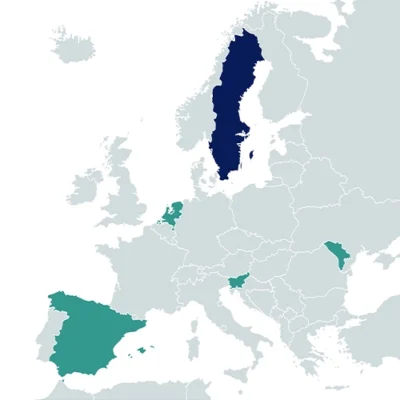
- Department of Earth and Environmental Sciences, Lund University, Lund, Sweden
- Pyrenean Institute of Ecology, Spanish National Research Council (IPE-CSIC), Zaragoza, Spain
- Department of Natural Resources, Faculty of Geo-Information Science and Earth Observation (ITC), University of Twente, Enschede, The Netherlands
- Faculty of Natural Sciences and Agroecology, Alecu Russo Bălți State University, Bălți, Moldova
- Department of Landscape Architecture, Biotechnical Faculty, University of Ljubljana, Ljubljana, Slovenia
Context
The shift from fossil fuels to renewable energy sources such as solar, wind, hydropower, and bioenergy is essential for climate mitigation, but increasingly conflicts with biodiversity conservation. Large-scale renewable energy deployment often encroaches on natural ecosystems, causing habitat fragmentation, soil degradation, species displacement and disruption of terrestrial and aquatic systems. This creates a critical paradox: climate mitigation solutions may undermine biodiversity if ecological considerations are not integrated into planning and implementation.
Although European policies endorse ‘do-no-harm’ principles, they offer limited guidance for renewable energy transition (RET) planning. Regulatory frameworks lack robust, standardised criteria to prevent biodiversity loss and assess cumulative impacts across landscapes. Addressing these gaps is urgent and strengthening biodiversity safeguards within decarbonisation pathways is fundamental to sustainable development, ecosystem resilience and the long-term credibility of climate and energy policies.
Main objectives
BRET aims to deliver evidence-based guidance for renewable energy planning and implementation. The project will:
- establish robust biodiversity baselines to inform site selection and spatial planning;
- develop a dynamic ecological impact assessment framework covering the full life cycle of renewable energy installations, integrating DPSIR analysis with stakeholder engagement;
- operationalise biodiversity valuation by combining ecological, economic, and socio-cultural perspectives;
- use integrated case studies across Europe to translate scientific evidence into actionable recommendations that strengthen biodiversity safeguards in renewable energy development.
Main activities
The project will generate policy-relevant evidence and guidance for biodiversity-positive renewable energy development. By combining Earth observation, field surveys and microclimate modelling, it will establish robust biodiversity baselines and assess impacts of renewable energy infrastructure on habitats, species and ecosystem functions and services. These insights will inform a practical ecological impact assessment framework, structured around the DPSIR approach, to strengthen biodiversity safeguards. The project will also develop biodiversity valuation methods that integrate ecological indicators with economic and socio-cultural perspectives, capturing how impacts are perceived, valued and contested by different actors.
Strong emphasis is placed on knowledge transfer and stakeholder engagement to ensure societal relevance and policy uptake. Policymakers, energy developers, environmental authorities, NGOs and local communities will be involved through interviews, deliberative workshops and case studies across Europe, enabling co-production of solutions and early testing of policy options. Results will be shared through policy briefs, technical guidance, open-access data and tools, scientific publications and targeted dialogue events aligned with European policy processes. By translating scientific evidence into actionable recommendations, the project will support transparent, biodiversity-sensitive spatial planning and help align renewable energy deployment with European biodiversity and climate objectives, strengthening public trust and long-term policy legitimacy.