
Reforestation of forests and orchards after disturbances: A transformative action plan balancing socioeconomic and biodiversity needs
Call
Duration
01/04/2026 – 31/03/2029
Total grant
Approx. 2.3 mil €
More information
Partners of the project
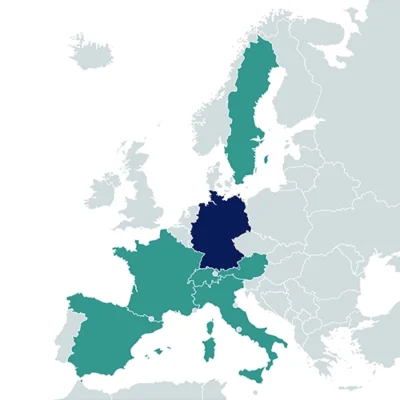
- Department of Applied Natural Science and Health, University of Applied Science and Arts Coburg, Coburg, Germany
- Department of Agricultural and Food Science, University of Bologna, Bologna, Italy
- Department Forest Health and Biotic Interactions, Swiss Federal Institute WSL, Birmensdorf, Switzerland
- Institute for Natural Science, Design and Sustainable Building, Mid Sweden University, Östersund, Sweden
- Department of Forest- and Soil Sciences, Institute for Forest Ecology, BOKU University, Vienna, Austria
- Department Ecological Mindsets, Acteon, Grenoble, France
- Department Computer Language and Sciences, University of Malaga, Malaga, Spain
- Mountain Ecosystems and Societies Laboratory, National Institute for Agricultural, Food, and Environmental Research, Saint Martin d`Heres, France
Context
The BIOREFOREST project aims to initiate a societal transformation towards optimising reforestation strategies for forests and orchards, integrating biodiversity as a key factor in the planning process. The project focuses on European forest sites affected by natural disturbances and reforested as monospecific stands (including orchards) or mixed-species stands, as well as naturally regenerated sites with minimal management intervention. Reforestation sites and their spatial and temporal development will be identified using satellite data from the past 50 years. Policy makers, forest and orchard owners will be engaged throughout the project to ensure reforestation strategies are practical, adopted widely, and aligned with the EU Forest Strategy, the Nature Restoration Law, and the Soil Mission.
Main objectives
The main objectives of BIOREFOREST are to:
- assess the impacts of different reforestation strategies on biodiversity and economic outcomes across spatial and temporal scales;
- evaluate the interaction between disturbance and reforestation success;
- develop site-specific reforestation approaches that balance ecological and economic needs, and provide tailor-made strategies for stakeholders;
- create a decision-support system that helps balance biodiversity goals and economic needs using eXplainable Artificial Intelligence (XAI);
- identify and extract key taxonomic and functional indicators to monitor current and future reforestation effects on biodiversity and to predict the impacts of reforestation strategies.
Main activities
BIOREFOREST will combine advanced data collection, modelling, AI and participatory approaches to guide reforestation decisions. The project will engage landowners and policy makers in a collaborative activity network, collecting site-specific information through customised surveys. At selected sites, systematic sampling of soil, leaves and deadwood will be carried out to gather ecological data. Plant biodiversity will be monitored using citizen science tools, which will not only provide valuable observations but also empower participants, increase their environmental self-efficacy, and encourage behavioural change. Multitrophic biodiversity will be analysed using metagenomics, and the resulting data will be functionally annotated. Remote sensing information, together with metadata from forest and orchard sites and biodiversity measurements, will support the modelling of ecosystem services and carbon sequestration using the LPJ-GUESS model. All collected data will then be used to train, validate and test XAI models capable of assessing site-specific reforestation strategies and identifying important markers for decision support. Throughout the project, forest and orchard owners, land managers and policy makers will participate in workshops, training sessions and self-sampling campaigns to ensure that reforestation strategies are practical, widely adopted and aligned with relevant EU policies.