
Social-ecological KEystone places for Transformative Change in safeguarding coastal biodiversity
Call
Duration
01/03/2026 – 28/02/2029
Total grant
Approx. 1.2 mil. €
More information
Partners of the project
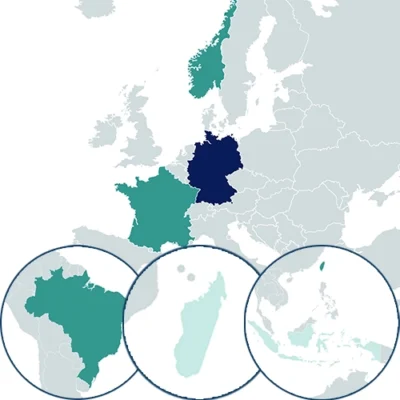
- Programme Area ‘Societal Impact’, Leibniz Centre for Tropical Marine Research (ZMT) GmbH, Bremen, Germany
- Department of Oceanography, Federal University of Pernambuco, Recife, Brazil
- UMR ESPACE, University of the Côte d’Azur, Nice, France
- Department of Geography, National Taiwan University, Taipei, Taiwan
- Department of Biosciences, University of Oslo, Oslo, Norway
- International Research Institute for Maritime, Ocean and Fisheries, IPB University, Bogor, Indonesia
- Kōrero o te ‘Ōrau, Rarotonga, Cook Islands
- Institute of Fisheries and Marine Sciences, University of Toliara, Toliara, Madagascar
Context
The SKETCH project focuses on empowering Indigenous Peoples and Local Communities (IPLCs) to protect coastal ecosystems through equitable, interdisciplinary conservation strategies. The project introduces the concept of Social-Ecological Keystone Places (SEKPs) – critical areas where nature and society are deeply interconnected – as transformative hubs for biodiversity safeguarding and sustainable governance.
Main objectives
- Evaluate the ecological, cultural, and social significance of SEKPs across five diverse case studies in Brazil, Madagascar, Indonesia, Taiwan, and the Cook Islands.
- Enhance community-led management systems aligned with global conservation frameworks like Other Effective Area-Based Conservation Measures (OECMs).
- Combine local knowledge with innovative methods like participatory eDNA metabarcoding, participatory mapping, and digital storytelling.
- Co-develop actionable recommendations for policy processes to integrate SEKPs into national and international biodiversity strategies.
Main activities
Using a participatory action research framework, SKETCH unites IPLCs, scientists, and policymakers to co-produce knowledge. Six interconnected work packages guide the project: WP1-WP3 focus on characterising SEKPs, analysing governance structures, and developing inclusive biodiversity monitoring tools; WP4-WP5 explore pathways for OECM recognition through scenario planning and interdisciplinary collaboration; and WP6 synthesises findings to inform global biodiversity policies. SKETCH introduces the ‘Ripples of Knowledge and Transformation’ framework to connect local insights with global conservation goals. By integrating cultural and scientific narratives with ecological data, the project seeks to redefine conservation as socially just and culturally informed. Expected outcomes are:
- improved understanding of SEKPs’ role in biodiversity conservation;
- scalable tools for IPLC-driven monitoring and policy integration;
- policy briefs and transformative strategies for OECM recognition;
- strengthened international networks for equitable coastal and marine biodiversity safeguarding.
By bridging Indigenous knowledge with scientific innovation, SKETCH ultimately aims to promote equity, sustainability, and community empowerment in marine stewardship.