
Enhancing PLurivErsality for a Human Rights-Based Approach (HRBA): GoVERning the Climate-Biodiversity-Pollution Nexus
Call
Duration
01/04/2026 – 31/03/2029
Total grant
Approx. 1.7 mil. €
More information
Partners of the project
- Faculty of Natural Sciences, Stockholm Resilience Centre, Stockholm University, Stockholm, Sweden
- Department of Forestry, Biodiversity and Tourism, Makerere University, Kampala, Uganda
- Centre of Transdisciplinary and Sustainable Science, IPB University, Bogor, Indonesia
- School of Arts, Science and Humanities, University of São Paulo, São Paulo, Brazil
- Institute of Environmental Science and Technology & Department of Political Science and Public Law, Autonomous University of Barcelona, Barcelona, Spain
- Institute for Comparative Federalism, Eurac Research, Bolzano, Italy
- Educational Sciences, Free University of Brussels, Brussels, Belgium
- Centre for Development and Environment, University of Bern, Bern, Switzerland
- SwedBio, Stockholm Resilience Centre, Stockholm University, Sweden
- Soka Gakkai International, Office for UN Affairs, Grand Saconnex, Switzerland
Context
The climate-biodiversity-pollution nexus represents a critical convergence of environmental challenges. Addressing it is essential to halt or reverse biodiversity loss, yet major obstacles persist. Effective management requires holistic strategies that address the intertwined issues of climate change, biodiversity loss, and pollution. To realise these goals, many management instruments have been put forward. However, poorly designed instruments can inadvertently exacerbate trade-offs related to climate mitigation, biodiversity conservation, and the rights of Indigenous Peoples and Local Communities. There is a need to better understand how to manage the nexus in an effective and equitable way to ensure transformations toward more sustainable and just futures.
In this context, Human Rights-Based Approaches (HRBA) are gaining increased attention. HRBA act as cross-cutting approaches to key frameworks, such as the Kunming-Montreal Global Biodiversity Framework, and are not merely another instrument but represent a new paradigm that provides a transformative meaning to current management instruments. However, applying an HRBA remains challenging, as anthropocentric interpretations of HRBA often struggle to recognise the validity of different ways of life, which are not necessarily comparable, as well as the crucial role of non-human beings.
Main objectives
The objective of LEVER is to enhance pluriversality (the recognition of radically different ways of life) for HRBA which will serve as a transformative lever for the equitable and effective governance of the climate-biodiversity-pollution nexus.
Main activities
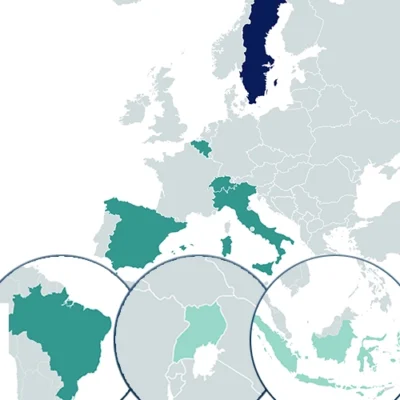
This will be achieved by integrating perspectives from law, the humanities, social sciences, and ecology through an in-depth empirical analysis of case studies from five countries: Brazil, Indonesia, Spain, Sweden, and Uganda. In these five countries, LEVER will work towards understanding local perspectives on the climate-biodiversity-pollution nexus, develop a pluriversal legal glossary and framework, explore HRBA effectiveness through participatory scenarios, identify cross-case enabling conditions for transformation, and, finally, operationalise policy guidance at national and international levels. This includes dialogue workshops with relevant CBD (Convention on Biological Diversity) caucuses and guidelines for practitioners and decision-makers on how to operationalise HRBA for pluriversal perspectives.