
Green Energy Transitions in Europe: Impacts on Biodiversity, Landscapes and Justice
Call
Duration
01/03/2026 – 28/02/2029
Total grant
Approx. 1.8 mil. €
More information
Partners of the project
- Working Group Environmental Justice in Agricultural Landscapes, Leibniz Centre for Agricultural Landscape Research, Müncheberg, Germany
- BC3, Basque Centre for Climate Change, Leioa, Spain
- Department of Social-Ecological Analysis, Global Change Research Institute of the Czech Academy of Sciences, Brno, Czech Republic
- Institute for Environmental Studies, Vrije Universiteit Amsterdam, Amsterdam, The Netherlands
- Research Unit Land Change Science, Swiss Federal Institute for Forest, Snow and Landscape Research, Birmensdorf, Switzerland
- Centre for Sustainability Studies, Lund University, Lund, Sweden
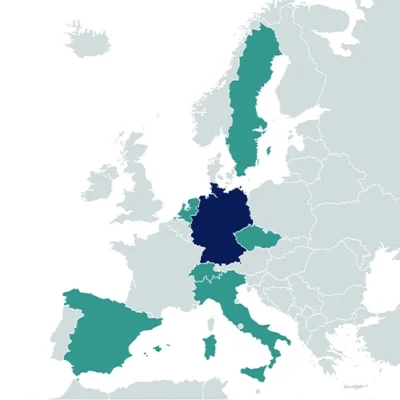
- Department of Civil, Environmental and Architectural Engineering, University of Padua, Padova, Italy
Context
Solar energy is a key pillar of Europe’s climate mitigation strategy, but its rapid expansion is transforming rural landscapes where biodiversity, agriculture, and cultural heritage intersect. Large-scale ground-mounted solar installations require substantial land, which can lead to habitat loss, landscape fragmentation, and social conflict, especially when projects are planned without meaningful involvement of local communities.
Current planning and assessment processes often do not sufficiently take into account biocultural diversity (the interdependence of biodiversity, local knowledge, and cultural values) as well as questions of environmental justice, such as who decides, who benefits, and who bears the costs of solar energy projects. If these dimensions are ignored, the green energy transition risks reproducing extractive and unjust patterns known from fossil fuel systems, undermining both biodiversity protection and public acceptance.
JustBioSolar addresses this challenge by examining ground-mounted solar energy deployment as a biodiversity-climate-society nexus, aiming to support a renewable energy transition that is not only low-carbon, but also nature-positive and socially just.
Main objectives
JustBioSolar aims to:
- Assess how large-scale solar projects affect biodiversity, including biocultural diversity, and perceptions of justice in different European rural contexts.
- Identify planning, governance, and communication practices that enable socially just and biodiversity-friendly solar development.
- Understand how power relations and policy discourses shape solar energy decisions from local to European levels.
- Co-develop practical principles and pathways for sustainable solar energy landscapes together with stakeholders.
Main activities
The project conducts in-depth case studies in Germany, Spain, Italy, and the Czech Republic, where solar deployment is rapidly expanding, complemented by cases in Sweden and Colombia that illuminate biodiversity and justice impacts associated with raw material extraction for solar technologies. JustBioSolar engages farmers, local residents, conservation groups, energy developers, and policymakers through a participatory approach that integrates scientific evidence with local knowledge and values. Comparative analysis across European cases identifies recurring trade-offs and conflict hotspots, generating practical guidance for policymakers and planners on anticipating risks, improving participation, and better aligning solar development with biodiversity and justice objectives. Engagement with decision-makers aims to improve planning practices, strengthen community involvement, and support policies that balance climate mitigation with biodiversity conservation and social equity.