“Strategic Biodiversity Monitoring Governance Document (Phase III): Recommendations towards harmonised biodiversity monitoring on transnational and national scales across Europe”
Published: March 2026 | DOI: 10.5281/zenodo.19492663
This report presents the Phase III results of Biodiversa+ work on biodiversity monitoring in Europe. It examines current limitations and sets out options to improve coordination, governance and monitoring practices across countries.
Key takeaways
- Coordinated governance: The report proposes a three-level structure (European coordination, national centres and thematic expert networks) to better connect monitoring efforts and support data use across scales.
- Common minimum requirements: Rather than full standardisation, it recommends shared baselines for monitoring design and data (including FAIR principles) to enable comparability across countries.
- More sustainable funding: It highlights the need to move beyond short-term project funding towards more stable support for core monitoring functions, including coordination, data infrastructure and long-term data collection.
- Integration of new technologies: Tools such as eDNA, remote sensing and bioacoustics can significantly improve monitoring coverage, but require standardisation, infrastructure and capacity to be deployed at scale.
- Removing practical barriers: The report identifies operational challenges, including administrative and legal constraints (e.g., cross-border sample handling), that limit the efficiency of transnational monitoring.
- Stronger alignment with policy needs: Monitoring should better support European and international biodiversity commitments, including the EU Biodiversity Strategy for 2030 and the Nature Restoration Regulation.
Context
Biodiversity monitoring in Europe is carried out through many national programmes and networks. These systems have developed independently, with differences in methods, coverage and data management. This makes it difficult to combine and use data at European scale, limiting their contribution to policy, research and large-scale assessments.
This fragmentation is not only a technical issue, but a structural limitation affecting how biodiversity data can support policy and decision-making. It reduces the overall value of existing monitoring efforts, even where data collection is extensive.
Better coordination would improve the usability of biodiversity data across Europe. It would support more consistent reporting and assessment, reduce duplication of effort and strengthen the evidence base for policy and decision-making. A more coherent monitoring system would also make better use of existing investments and support the implementation of European and international biodiversity commitments.
A coordinated European approach
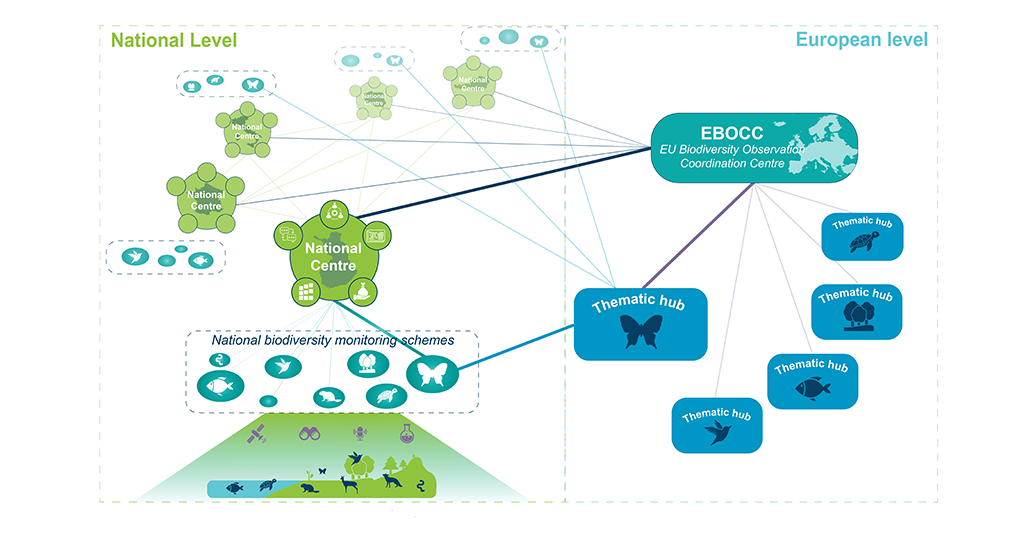
The report proposes a multi-level governance model that connects existing systems into a more coherent European framework.
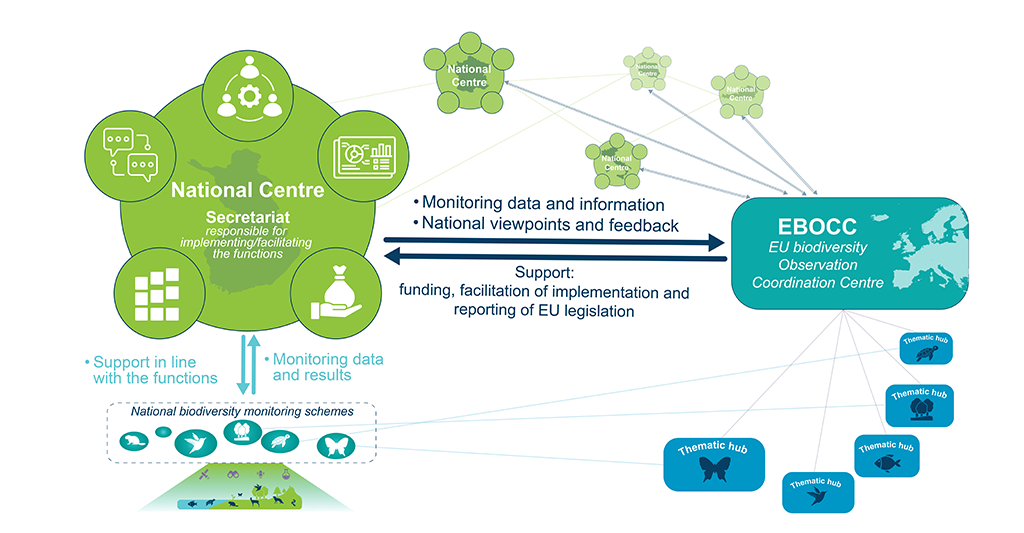
- European coordination is intended to support alignment across countries, data integration and European-scale assessments, including through a dedicated coordination function such as a European Biodiversity Observation Coordination Centre (EBOCC).
- At national level, Biodiversity Monitoring Coordination Centres (NBMCCs) would serve as entry points for transnational cooperation. These centres would not replace existing monitoring schemes, but connect and strengthen them by: 1) coordinating monitoring activities across institutions and domains; 2) supporting data mobilisation and interoperability; 3) building capacity; 4) connecting national efforts to transnational processes; and 5) communicating and engaging stakeholders.
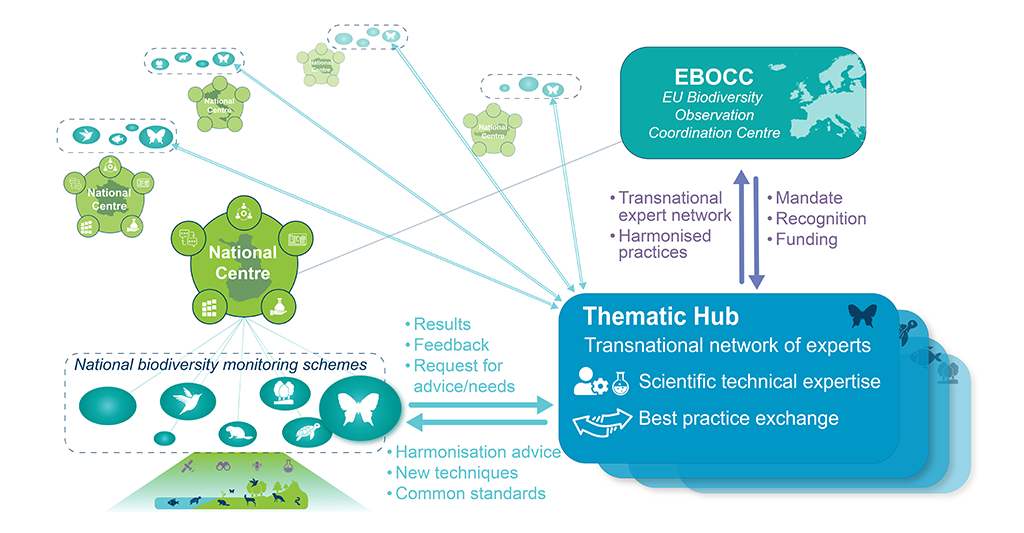
- Thematic Hubs would build on existing expert networks, such as those focusing on particular taxonomic groups, habitats or ecosystem components. Their role would include: 1) harmonising monitoring protocols, methodologies and tools; 2) producing European‑scale biodiversity indicators and trend analyses; 3) facilitating the exchange of best practices; 4) promoting data harmonisation through shared standards and vocabularies; and 5) acting as entry points to the wider European biodiversity observation system for stakeholders.
Together, these three components form a coordinated system in which European, national and thematic levels are connected. The aim is not to centralise monitoring, but to improve interoperability, reduce duplication and make better use of existing expertise and data.
What this requires in practice
Several elements are needed to make such a system work, including:
-
Harmonisation
Common minimum requirements are needed to improve comparability across countries.
These include:
- shared objectives aligned with policy needs and existing frameworks (e.g., Essential Biodiversity Variables),
- minimum standards for sampling effort, frequency and spatial coverage,
- agreed definitions of monitored entities (e.g., species, habitats, ecosystems),
- robust statistical design and quality control,
- application of FAIR data principles.
The aim is not full standardisation, but a shared baseline that allows data to be combined while preserving flexibility for national contexts.
-
Funding and sustainability
Monitoring requires stable support for core functions such as coordination, long-term data collection and infrastructure, alongside more flexible funding for innovation and new methods.
The report highlights several structural challenges, including:
- strong disparities in monitoring funding across countries and biodiversity domains,
- heavy reliance on short-term, project-based funding,
- underfunding of coordination, data management and integration.
It identifies the need for:
- stable national funding for core monitoring functions,
- EU-level co-funding for transnational coordination,
- exploration of public–private funding models, particularly where biodiversity data supports corporate sustainability reporting.
Sustained funding is closely linked to governance: clear institutional responsibilities are needed to secure long-term investment and avoid fragmentation of resources.
-
Technologies
New approaches such as eDNA, remote sensing, bioacoustics and automated monitoring can improve coverage and efficiency, but their wider use depends on appropriate conditions.
The report identifies key barriers to wider uptake:
- lack of standardised protocols and workflows,
- data management and storage challenges,
- limited technical capacity and training,
- uncertainty among policy authorities regarding operational use.
It calls for coordinated investment in shared infrastructure, harmonised data pipelines, capacity building and peer learning.
-
User needs
Monitoring priorities should be shaped by how biodiversity information is used in policy, research, management and other sectors.
The report proposes a structured, demand-driven approach to defining monitoring priorities, based on:
- identifying user needs across policy, research, conservation and private sectors,
- regular surveys and consultations,
- adapting priorities over time while maintaining long-term monitoring continuity.
This approach aims to improve the relevance, usability and uptake of monitoring data.
The full report provides detailed analysis and recommendations supporting these directions.