
“Mapping of the Business and Biodiversity Landscape for European Research & Innovation”
Published: January 2026 | DOI: 10.5281/zenodo.17396791
The role of businesses in addressing biodiversity loss is expanding rapidly, leading to a complex and crowded ecosystem of initiatives, frameworks, standards, and actors operating at global, European, and national levels. For policymakers, researchers, and businesses alike, understanding this landscape has become increasingly challenging.
This mapping provides a structured overview of this evolving field. It identifies key actors, initiatives, policy frameworks, and tools shaping how businesses engage with biodiversity, and highlights gaps, overlaps, and areas where greater coordination or public intervention could add value.
Main insights
Explore what this landscape means for different actors:
Biodiversity is becoming a strategic and operational issue for companies across sectors.
The mapping shows that business impacts and dependencies on biodiversity are now embedded in a growing set of EU and global policy frameworks, reporting requirements, and financial expectations. Biodiversity is no longer addressed only through voluntary initiatives or site-level mitigation, but increasingly through corporate strategy, risk management, and disclosure.
Key insights for businesses include:
- Rising expectations for impact and dependency assessment, driven by EU policies such as CSRD, the EU Taxonomy, and due diligence legislation.
- Growing reliance on tools, indicators, and external expertise, as companies struggle to translate ecological data into decision-relevant information.
- Persistent fragmentation between biodiversity strategies, operational practices, and reporting processes.
- Increasing value of collaboration with researchers, NGOs, and data providers to strengthen credibility, comparability, and robustness.
The mapping highlights that companies that invest early in biodiversity literacy, data use, and partnerships are better positioned to navigate regulatory change and future-proof their operations.
Financial flows are a powerful lever for transforming business-biodiversity relationships.
The mapping identifies financial institutions as central actors in the transition toward nature-positive economic systems. Banks, insurers, and investors increasingly face expectations to understand biodiversity-related risks, impacts, and dependencies across portfolios.
Key insights include:
- Biodiversity-related financial risk is gaining visibility, but assessment methods remain uneven and fragmented.
- A proliferation of frameworks and initiatives (e.g., disclosure tools, screening methodologies, voluntary alliances) is shaping practice, but comparability remains limited.
- Harmful financial flows still vastly outweigh positive investments, underlining the scale of transformation required.
- Data availability and consistency are major constraints for portfolio-level assessment and decision-making.
The mapping suggests that financial institutions can play a catalytic role by integrating biodiversity systematically into investment strategies, supporting data harmonisation, and aligning capital allocation with biodiversity objectives.
SMEs are central to biodiversity outcomes, but face distinct constraints.
The mapping emphasises that SMEs account for the vast majority of European enterprises and play a crucial role in value chains, local economies, and nature-based solutions. However, their capacity to engage with biodiversity agendas differs significantly from that of large companies.
Key insights include:
- Limited financial and human resources to manage complex biodiversity data, reporting, or compliance requirements.
- Growing indirect exposure to regulation, through supply-chain obligations imposed by larger partners.
- Insufficient access to tailored tools and guidance, as many initiatives focus on multinationals.
- Significant opportunity as providers of nature-based solutions, services, and innovation.
The analysis highlights the importance of simplified guidance, local support networks, and capacity-building measures to ensure SMEs can engage meaningfully.
Scientific knowledge is essential, but often poorly aligned with business and policy needs.
The mapping confirms that biodiversity research underpins all credible business and policy action. At the same time, it highlights a persistent gap between scientific outputs and the formats, scales, and timelines required by companies and financial institutions.
Key insights for researchers include:
- Critical knowledge gaps remain, particularly around genetic diversity, ecosystem functions, and cumulative impacts across value chains.
- Business demand is growing for applied, decision-relevant data, but scientific datasets are often difficult to translate into operational contexts.
- Metrics and indicators are diverse and inconsistent, complicating validation and comparison of corporate claims.
- Direct engagement with business actors improves the uptake and relevance of research outputs.
The mapping underscores the importance of interdisciplinary research and sustained dialogue between science, business, and policy to ensure that biodiversity knowledge informs real-world decisions.
Funding strategies shape how effectively biodiversity knowledge reaches practice.
The landscape analysis highlights the influential role of research and innovation funders in shaping the business–biodiversity agenda. Funding choices determine whether research remains siloed or contributes to systemic change.
Key insights include:
- Interdisciplinary and transdisciplinary research is essential, but still under-supported in many funding schemes.
- Knowledge transfer between research and business remains uneven, limiting impact.
- Pilot projects and demonstrators are critical for building trust, testing tools, and operationalising biodiversity action.
- Coordination across funding programmes is needed to reduce fragmentation and duplication.
The mapping points to the need for funding instruments that explicitly support collaboration between researchers, businesses, financial institutions, and data infrastructures.
Systemic change depends on alignment across policies, tools, and actors.
Looking across the full landscape, the mapping shows that progress on business and biodiversity is shaped by the interaction of policies, institutions, tools, and data infrastructures.
Key cross-cutting insights include:
- Increasing policy integration, with biodiversity embedded across EU environmental, financial, and corporate governance frameworks.
- A growing but fragmented ecosystem of tools and initiatives, creating challenges for comparability and coherence.
- Persistent data and measurement challenges, limiting accountability and trust.
- Capacity building as a recurring need, particularly for SMEs and public–private collaboration.
The mapping reinforces that addressing biodiversity loss requires coordinated action across research, policy, finance, and business, not isolated solutions.
Explore the landscape
By looking across actors, policies, tools, and initiatives, the mapping shows recurring patterns: increasing policy integration, a growing yet fragmented ecosystem of tools, and persistent challenges around measurement, comparability, and data flows.
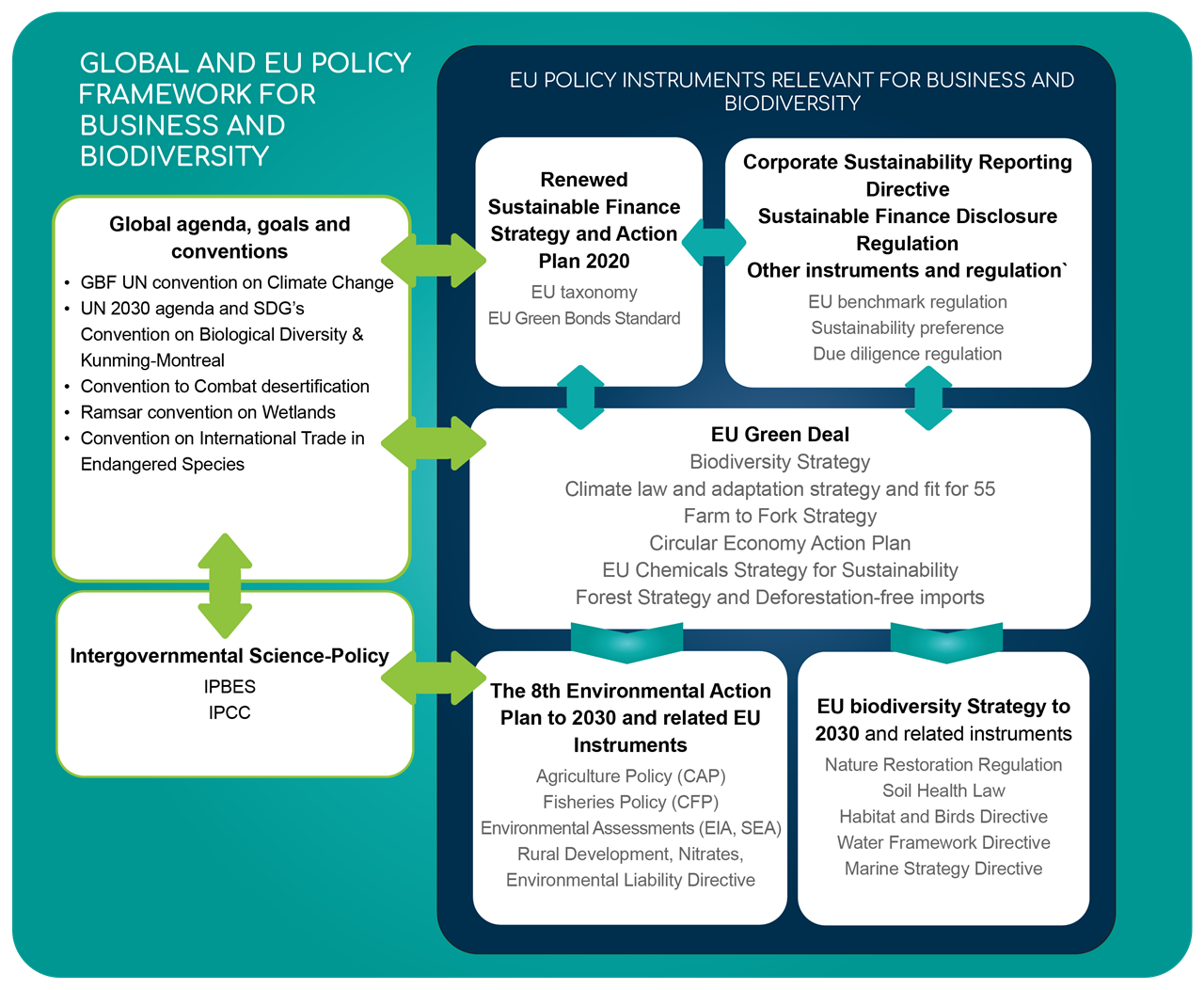
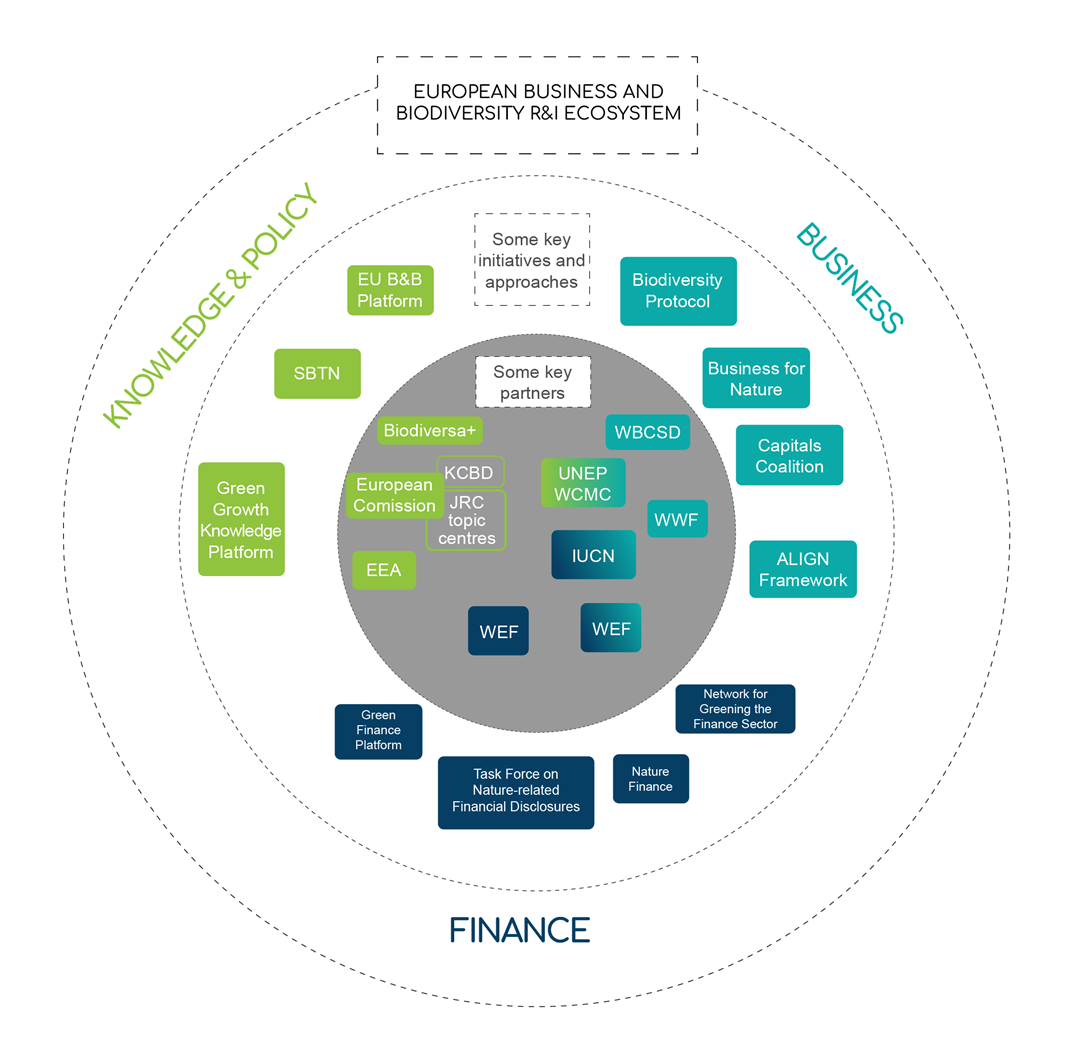
Use the interactive tool below to explore key actors, policies, initiatives, and tools, and to see how they connect across research, finance, business, and public policy in Europe.
No results found. Try adjusting your filters or search term.
This guide is part of a broader set of Biodiversa+ reports on how biodiversity data are used and shared by businesses.