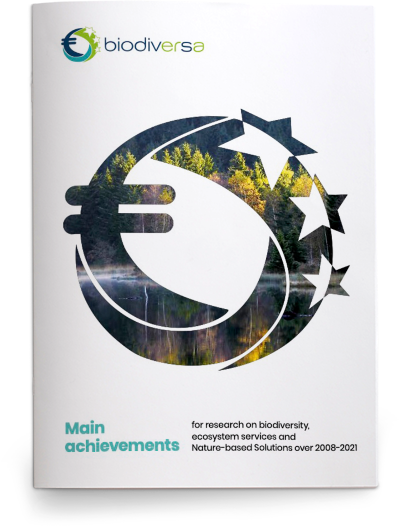
“BiodivERsA main achievements over 2008-2021”
Published: November 2021
This publication looks back at the main achievements of BiodivERsA between 2008 and 2021, before its evolution into Biodiversa+, the European Biodiversity Partnership.
BiodivERsA was the European network of research programmers and funders on biodiversity, ecosystem services and Nature-based Solutions. It helped strengthen cooperation between national and regional research funders, ministries, local authorities and the European Commission, and supported a more coordinated European Research Area on biodiversity.
Over this period, BiodivERsA developed joint research calls, mapping and foresight activities, shared research priorities, stakeholder engagement tools, science-policy work and capacity-building resources for the research community.
Key figures
Over 2008-2021, BiodivERsA:
- brought together 39 partners from 25 countries;
- launched 10 joint research calls;
- mobilised around €269 million in total project costs, including €178 million in cash funding;
- supported 147 transnational research projects;
- funded 1,025 research teams and 3,732 researchers;
- contributed to more than 1,300 peer-reviewed articles from funded research;
- supported research with strong citation levels and a growing scientific output;
- referenced 11,500 funded projects through the BiodivERsA database;
- developed capacity-building tools on stakeholder engagement, policy relevance, data management, biodiversity scenarios and citizen science;
- prepared the transition towards Biodiversa+.
Main areas of achievement
Beyond these figures, the publication traces how BiodivERsA helped structure European biodiversity research and strengthen its links with policy and practice.
- Building European cooperation on biodiversity research. BiodivERsA helped align research programming and funding across Europe at a time when biodiversity research was still fragmented across countries, disciplines and institutions. The network grew over time to include partners from across Europe. It also created a model of shared responsibilities, with partners leading call secretariats, policy briefs, data management workshops, stakeholder engagement guidance, research infrastructure mapping and other joint activities.
- Mapping research and anticipating future needs. BiodivERsA invested in mapping and foresight to better understand the European biodiversity research landscape and identify emerging priorities. This included the BiodivERsA database, mapping of biodiversity research infrastructures, mapping of international research collaborations, and work on knowledge and technology transfer organisations. Foresight activities helped define future call topics and anticipate research needs on issues such as Nature-based Solutions, biodiversity and health, biodiversity and climate change, and ecosystem restoration.
- Developing shared priorities. BiodivERsA developed a Strategic Research and Innovation Agenda to support a shared long-term vision between partners. This helped connect research programming with policy and societal needs, and provided a basis for joint calls on topics such as biodiversity dynamics, ecosystem services, invasive species, biodiversity and food supply, biodiversity and climate change, biodiversity and health, and ecosystem restoration.
- Supporting transnational research. Through its joint calls, BiodivERsA supported transnational research projects combining scientific excellence, interdisciplinarity and relevance for policy and practice. Projects funded through BiodivERsA brought together teams from different countries and disciplines, and encouraged researchers to work with stakeholders from the design stage through to the use of results.
- Strengthening research capacity and impact. BiodivERsA developed guidance and training to help researchers improve the policy relevance and societal impact of their work. These resources covered stakeholder engagement, science-policy interfacing, biodiversity scenarios, data management and citizen science. BiodivERsA also promoted better data management practices and open science principles through dedicated guidance and workshops for funded projects.
- Linking research with policy and practice. BiodivERsA worked to make biodiversity research more useful for policy makers, practitioners and other stakeholders. This included policy briefs, knowledge brokerage, stakeholder engagement guidance, collaboration with IPBES, and support for projects working with public authorities, managers, practitioners and civil society organisations.