
Bridging Ice Climate Technologies and Governance for Biodiversity in the Arctic
Call
Duration
01/01/2026 – 31/12/2028
Total grant
Approx. 1.3 mil. €
More information
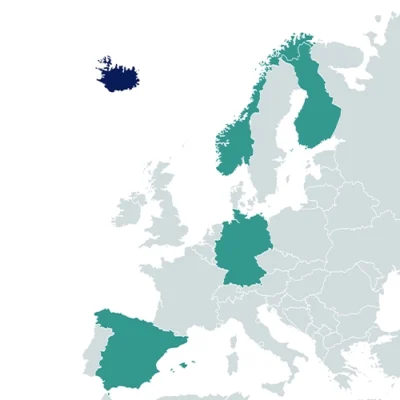
Partners of the project
- Stefansson Arctic Institute, University of Akureyri, Akureyri, Iceland
- Faculty of Social Sciences, Nord University, Bodø, Norway
- Arctic Centre, University of Lapland, Rovaniemi, Finland
- Húsavík Research Center, University of Iceland, Húsavík, Iceland
- Alfred Wegener Institute, Helmholtz Centre for Polar and Marine Research, Bremerhaven, Germany
- Department of Geography, Autonomous University of Barcelona, Cerdanyola del Vallès, Spain
Context
The Arctic Ocean is in crisis, with accelerating sea ice loss threatening global biodiversity, climate stability, and Indigenous livelihoods. While climate engineering technologies, specifically sea ice geoengineering (i.e., technologies designed to manipulate the region’s albedo and thermal energy) are increasingly proposed to restore ice, the current legal framework is fragmented and lacks a single international regulation governing these interventions. It remains uncertain how these technologies might impact complex marine ecosystems or exacerbate social inequalities. Consequently, there is an urgent need for new governance frameworks to ensure that any potential deployment of sea ice geoengineering addresses biodiversity loss without creating new environmental or social injustices.
Main objectives
Focusing on three key regions (the Beaufort Sea, Barents Sea, and Central Arctic Ocean), ICE BRIDGE will contribute to transformative governance change, providing policy recommendations that align Arctic climate interventions with the Convention on Biological Diversity and EU strategies. ICE BRIDGE aims to develop governance frameworks that ensure the responsible use of geoengineering technologies to mitigate and reverse biodiversity loss while promoting environmental justice. Specifically, it will produce regionally specific biodiversity and climate modelling data across three Arctic Large Marine Ecosystems to assess the risks and benefits of sea ice geoengineering. The project aims to create governance models that are equitable, transparent, and grounded in the precautionary principle.
Main activities
The main activities of ICE BRIDGE will be:
- conduct a systematic legal analysis of international and regional frameworks to identify regulatory gaps regarding sea ice geoengineering;
- evaluate climate and environmental justice implications to ensure risks and benefits are equitably distributed among global and regional stakeholders;
- use advanced climate modelling to simulate how different interventions affect ocean circulation, sea ice stability, and biodiversity;
- assess biodiversity impacts on marine food webs and species distributions using long-term ecological data and Indigenous Knowledge; and
- facilitate climate science diplomacy and participatory engagement with policymakers and Indigenous communities to collaboratively design governance scenarios.